
Founder and Principal Consultant


If your deadline is inside the next seven days, skip ahead and call us. Everything else on this page can wait until after that call.
A Procedural Fairness Letter, usually called a PFL, means an IRCC officer has a specific concern about your application and is required to give you the chance to answer it before deciding.
Read that again, because in the panic most people miss it. A PFL is not a refusal. It is the officer telling you in advance exactly what is about to sink your application, and giving you one opportunity to fix it.
At SAAB Immigration we respond to procedural fairness letters constantly, across study permits, work permits, spousal sponsorship, Express Entry and permanent resident cases. We know what officers are looking for in an answer, because we have seen what satisfies them and what does not.
Officers issue a procedural fairness letter when they are looking at something that would lead them to refuse, and fairness requires that you get to answer it first. The concern is usually one of these:
Your letter will identify which one applies. Everything about a successful response depends on answering that specific concern, with evidence, rather than re-explaining your application in general terms.
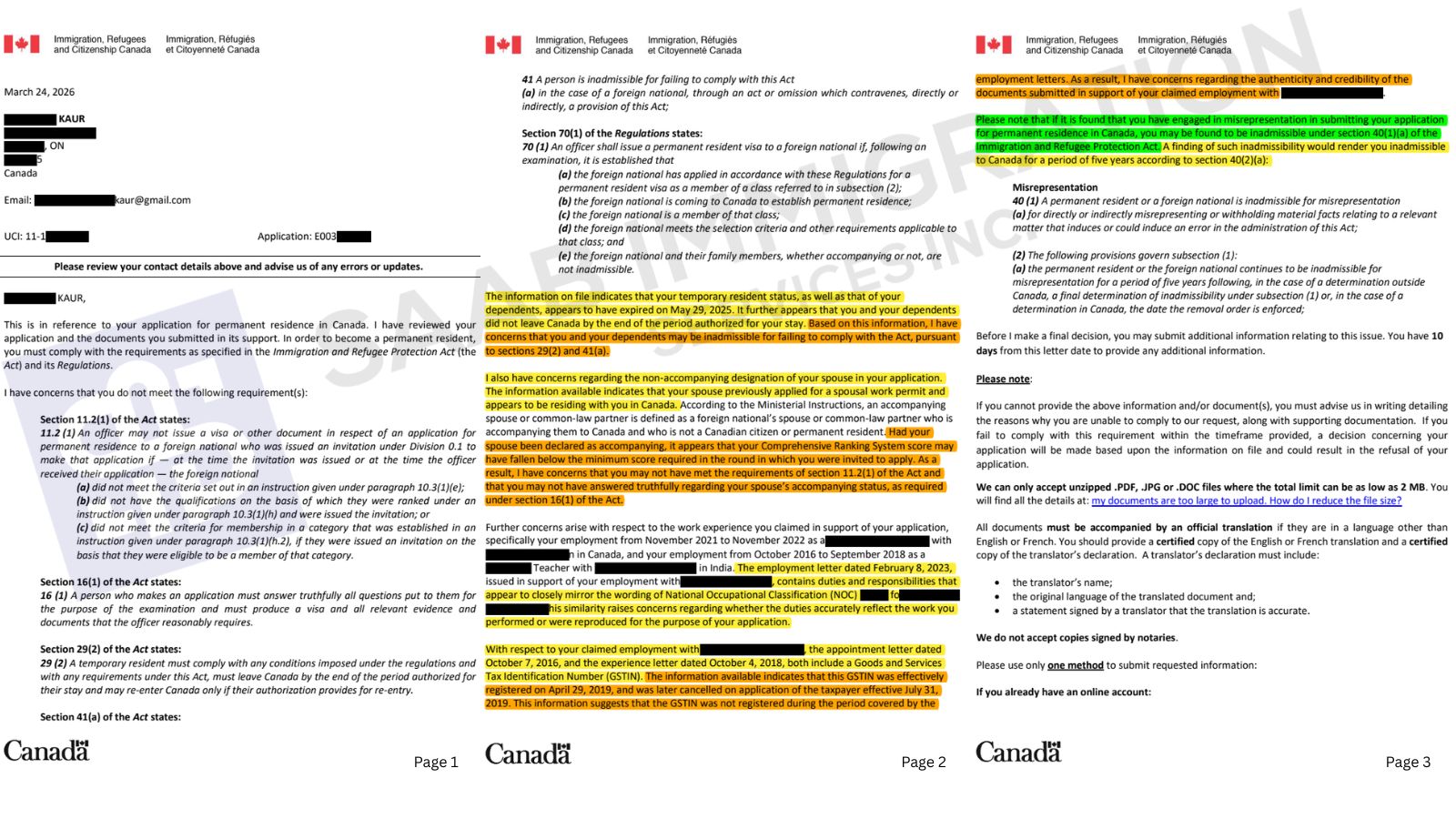
Every procedural fairness letter is serious. A misrepresentation procedural fairness letter is in a category of its own.
Under section 40 of the Immigration and Refugee Protection Act, a finding of misrepresentation under section 40 of IRPA makes you inadmissible to Canada and carries a five year bar on applying. It attaches to you personally rather than to the application. It follows you into every future application, it has to be disclosed, and some countries share this information.
Misrepresentation also does not require that you intended to deceive. Innocent errors, omissions made on an agent’s advice, and mistakes you did not personally make can still support a finding if the officer concludes they could have induced an error in the administration of the Act. Saying that your agent completed the forms is not on its own an answer, although how the error happened is often central to the response.
A response that works addresses materiality, addresses intent, proves the true facts with documents, and where there was an error explains it credibly instead of denying it. This is precise work, and the cost of getting it wrong is five years of your life.
A response is a submission, not a form. There is no template that works, because the entire exercise is answering one officer’s one concern. Strong responses share a structure:
If you do not answer the procedural fairness letter, the officer decides on the record already in front of them, which is the record that concerned them in the first place. In practice that means refusal.
It also closes doors you may want later. If you are refused after failing to answer a PFL, you cannot credibly argue at the Federal Court that you were denied procedural fairness, because you were given it and did not use it. The procedural fairness letter is the fairness. Once it has been offered, that argument is gone.
This is why the PFL stage is the single best opportunity in your file to change the outcome. Answering it properly now is faster, simpler and far more likely to succeed than challenging a refusal at the Federal Court later.
You can read how this plays out on real files in our case studies, including a 16 year old spousal sponsorship refusal we overturned, a PGWP restoration granted after loss of status, and the five mistakes that most often lead to study permit and PGWP refusals.
Dikshit Soni, RCIC (R536007) acts as your authorized representative for the response. If your matter later needs the Federal Court, it is handled by Dr. Pallavi Kataria of Pallavi Law Office, and we stay on the file alongside her.
A recent file of ours, set out in full on the blog. The client came to us after the letter had already been issued, on an application another representative had filed.
An Express Entry applicant had been invited and the application was already filed. His spouse was in Canada on a spousal open work permit, with dependent children, but the previous representative had filed with the spouse marked non-accompanying. IRCC issued a procedural fairness letter citing paragraph 41(a) read with subsection 16(1) of the Immigration and Refugee Protection Act, raised possible inadmissibility, and gave seven days to reply. He did not hold copies of his own file and did not know what had been submitted on his behalf.
Answer the officer’s concern inside the window that was left, without creating a misrepresentation problem that the record did not already contain, and if the facts allowed it, correct the family composition on an application still in process rather than abandoning it and starting again.
He retained us with one day left on the clock. We obtained and read the actual file rather than working from a description of it, identified which limb of the Act the officer was in fact on, and answered that. The response went in the next day, inside the seven days, with a supplementary submission the day after. No document was created for the purpose.
IRCC requested processing fees for the spouse and a dependent child as part of the same application. Non-accompanying to accompanying, same application number, the file still in process, six days from the day we were retained.
A fee request is not an approval, and no outcome on any other file can be inferred from this one. Immigration decisions turn on their own facts. We have handled a number of these. This one is published because the documents can be shown.