

- A procedural fairness letter over a spouse marked non-accompanying is now one of the most common letters we see on Express Entry files. It is not a refusal, and it is not a misrepresentation finding.
- These letters usually cite paragraph 41(a) read with subsection 16(1) of the Act, which is a failure to comply. That is a different thing from section 40, misrepresentation, which carries a five year bar. The distinction decides how the letter should be answered.
- The response window is often seven days. That is short, and it is the reason bad advice gets taken.
- In a file we completed this month, the spouse and a dependent child went from non-accompanying to accompanying on the same application, under the same application number, already in process. IRCC requested their fees six days after we were retained.
- Your file belongs to you. Under the College’s Code of Professional Conduct a licensee must return your documents, and must deliver the file to a new representative within ten business days. A termination agreement cannot buy your silence.
- We are not publishing the argument that carried this file. The general law is below. The application of it to your facts is the work.
If you search for what happens when IRCC sends a procedural fairness letter about a spouse who was declared non-accompanying, you will find a great deal of certainty and very little law. The consensus online is that the file is finished, that inadmissibility follows, and that there is nothing to be done.
That is not what we see in practice, and it is not what the Act says.
What follows is the general framework, written from files we have actually run, and one recent example with the outcome. We have deliberately left out the argument that resolved it. The reason for that is set out near the end, and it is not coyness.
What the letter usually says
The pattern is consistent. The officer notes that the applicant declared a spouse as non-accompanying in the Express Entry profile, and that the spouse has in fact been residing with the applicant in Canada, often on a spousal open work permit issued on the strength of the applicant’s own status.
The officer then sets out the definition of an accompanying family member from the Ministerial Instructions, which turns on the spouse accompanying the applicant to Canada and not being a citizen or permanent resident, and observes that the spouse appears to meet it.
The letter then quotes two provisions:
Paragraph 41(a) of the Immigration and Refugee Protection Act, under which a foreign national is inadmissible for failing to comply with the Act through an act or omission which contravenes, directly or indirectly, a provision of the Act.
Subsection 16(1), under which a person who makes an application must answer truthfully all questions put to them for the purpose of the examination, and must produce all relevant evidence and documents the officer reasonably requires.
The officer says the concern is that the applicant may be inadmissible under 41(a) for not having met the requirement in 16(1), invites information that would allay the concern, and gives a deadline. In the file described below, the deadline was seven days from the date of the letter.
41(a) is not section 40, and the difference is the whole case
This is the single most important thing to understand before you answer, and it is almost never explained properly.
Section 40 is misrepresentation. It applies where a person directly or indirectly misrepresents or withholds material facts relating to a relevant matter, in a way that induces or could induce an error in the administration of the Act. A finding under section 40 carries a five year period of inadmissibility.
Paragraph 41(a) is failure to comply. It is engaged by an act or omission that contravenes a provision of the Act. It carries no fixed statutory bar of that kind.
A letter framed on 41(a) and 16(1) is telling you something. The officer is raising a compliance concern about the accuracy of a declaration, not alleging that facts were hidden. Where the spouse was declared on the application, examined on the application, and her passport, photograph, medical examination and police certificate were all filed with it, nothing was concealed from the Department. What is in issue is the correctness of a single designation attached to a person who was fully disclosed.
That is a defensible position, and it is a very different conversation from a section 40 allegation. Answering a 41(a) letter as though it were a section 40 letter, by apologising and explaining, is how people talk themselves into a problem they did not have.
Why these letters are appearing so often
The designation is easy to reach for, because the arithmetic is unforgiving. A candidate is in the pool with a spouse on the profile. Including the spouse produces one score, excluding her produces a higher one, and the higher one clears the round while the lower one does not. Marking the spouse non-accompanying converts a near miss into an invitation.
What the system does not do at the profile stage is check whether the spouse is standing next to you in Canada on a permit issued because of you. IRCC checks that later, at the application stage, when the officer has the full picture including the spouse’s own permit history. That is when the letter comes.
So this is not a rare trap. It is a predictable consequence of a common shortcut, and the volume of these letters has risen accordingly.
The seven days is the real danger
Almost everything that goes wrong on these files goes wrong because of the deadline.
Seven days is not enough time to obtain a file you do not have, take a second opinion, and prepare a response. It is exactly enough time to panic. And panic is when people accept the two suggestions we see most often.
The first is to ask for an extension. Sometimes appropriate. Often it simply spends the time you have and produces nothing, because there is no entitlement to one and an officer under a service standard is not obliged to grant it.
The second is to produce a reason the spouse could not travel. This is where files are lost. A medical letter, a family emergency abroad, something that makes the original designation look accurate after the fact. We have seen these circulated as blank templates with the name and the condition left for the applicant to fill in. If you are handed a pre-drafted physician’s letter with gaps in it, you are being asked to manufacture evidence, and you should stop.
The applicant in the file below was sent two such templates. He obtained neither. That decision is the reason he still has an application.
Your file is yours, and the College says so
A recurring and serious problem in these cases is that the applicant does not have their own documents. They do not know what was uploaded, what was declared, or what explanation was given, because the office that filed it never gave them copies.
That is not a grey area. Under the Code of Professional Conduct for College of Immigration and Citizenship Consultants Licensees:
- Section 36(1)(a): when the service agreement is completed, or terminated before completion, the licensee must return the client’s documents to the client.
- Section 36(2)(a): the licensee must provide the client with all information in the licensee’s possession that may be required in connection with the client’s file.
- Section 36(3): where representation is transferred, the file must be delivered to the successor representative within ten business days of the request.
- Section 6: a licensee must be honest and candid when advising their clients.
- Section 19(1): a licensee must fulfil their professional obligations competently and diligently.
- Section 35(2): a licensee must advise a client that dishonest, fraudulent or illegal conduct should not be pursued.
Withholding a client’s own file until they sign something is not a fee dispute. Neither is a clause in a termination agreement that requires the client to refrain from making complaints to any regulatory or governing body. You cannot contract out of a regulator’s jurisdiction, and a client who signs such a clause to get their documents back has not given up anything they actually had.
If you are in this position, ask in writing, cite section 36, and keep the reply.
The file, and what happened
This is recent, and the client has asked only that it be told accurately.
He is a former international student who completed a Canadian credential and moved onto a post-graduation work permit, in continuous skilled employment throughout. His wife has been in Canada with him since 2024 on a spousal open work permit issued on the strength of his status. Their elder child is here. Their younger child was born in Canada in late 2025 and is a Canadian citizen.
He received his invitation to apply. With his wife on the application his score fell below the cut-off for that round. His representative’s solution was to mark her non-accompanying, and the application went in that way.
He was uneasy about it from the start. He raised the risk of a fairness letter with that office more than once and was told not to worry.
On 3 September 2026 the letter arrived. Paragraph 41(a), subsection 16(1), seven days.
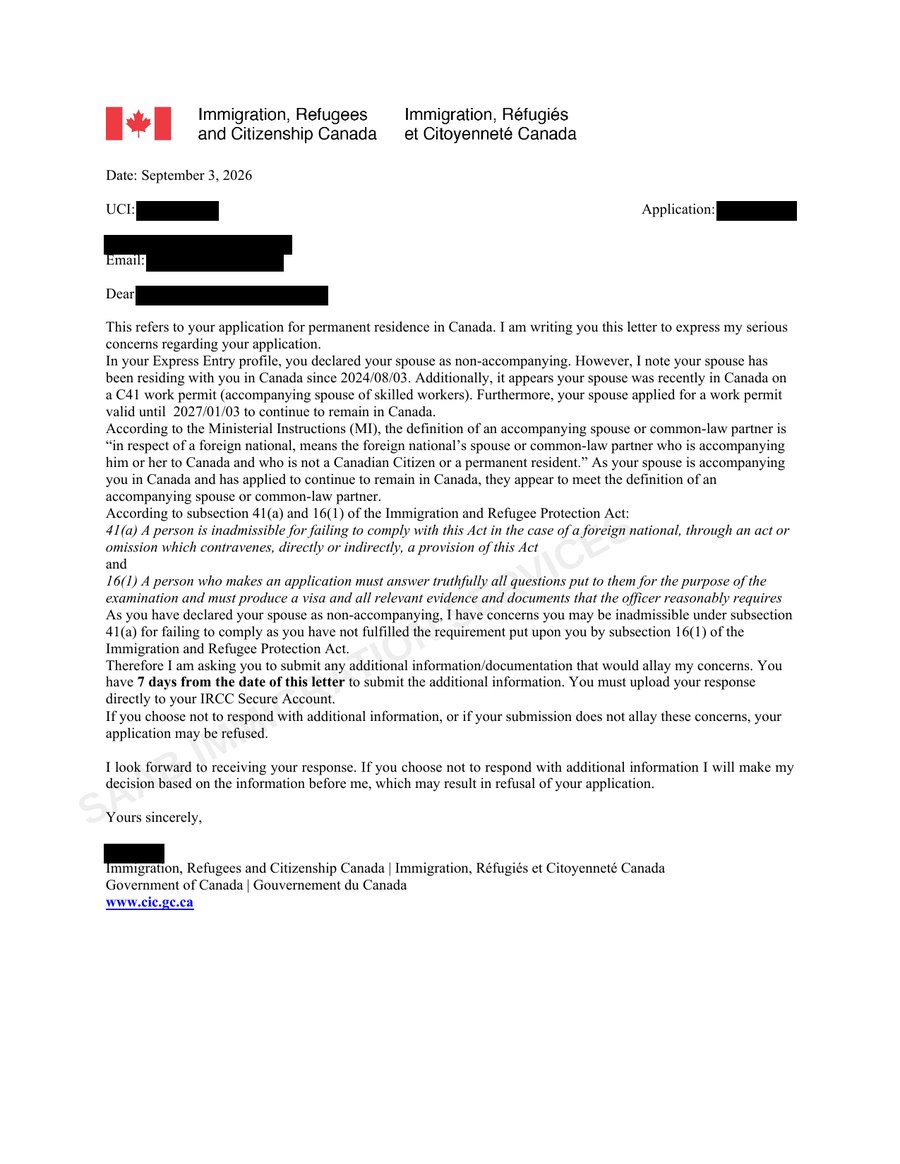
The fairness letter as it arrived, with all identifying details removed. Note the legal basis the officer names, and the deadline.
He had been following our posts for some time and reached out as a member of the public. We told him what we thought the correct legal position was and suggested he put it to his own representative, who was the office instructed on his file. He did. It was refused in writing, and not on the basis that it was wrong. He was offered an extension he did not want and two pre-drafted physician’s letters he declined to use. He also discovered that he could not obtain his own application documents from the office that held them without signing a termination agreement.
He terminated that retainer and instructed us with one day left on the deadline.
We filed the response the next day, on 10 September 2026, inside the seven days, and a supplementary submission the day after that. On 15 September 2026 IRCC wrote asking for the processing fees for his wife and his elder child, identifying both as part of the application.
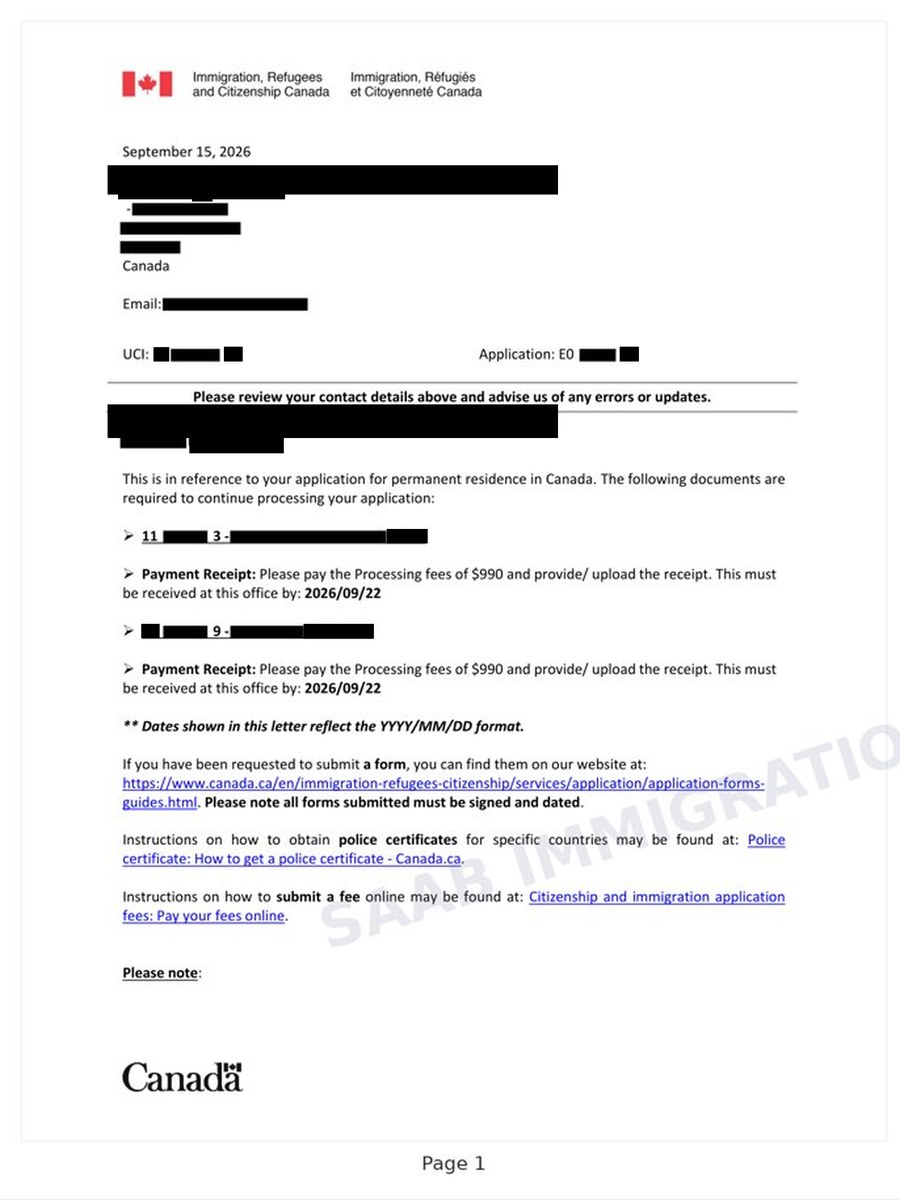
The request that followed on 15 September 2026, redacted. Two processing fees at $990, payable by 22 September 2026, for the two family members who had been marked non-accompanying.
The spouse and the child moved from non-accompanying to accompanying on the same application, under the same application number, already in process. Six days from the day we were retained.
What we have not published, and why
The legal framework above is public. The provisions are public, the Ministerial Instructions are public, and the Code of Professional Conduct is published in the Canada Gazette. None of that is proprietary and all of it is useful to you.
The argument that carried this file is not on this page. It is a reading of the Act applied to a narrow set of facts, supported by the Department’s own published policy, and it was available to anyone acting on that file from the day the letter arrived. It was not run because the office holding the file did not want to run it.
We are not publishing it for two reasons. The first is that a legal argument lifted from a blog and applied to different facts is how people get refused. The second is more practical. What made this work was not a form of words. It was reading the actual file, identifying which limb of the Act the officer was on, and building the record around the client’s own conduct, which in this case was the strongest evidence available.
If you have a fairness letter in front of you, the useful question is not what argument worked for somebody else. It is what is actually in your file, which is a question that can only be answered by looking at it.
If you have one of these letters now
Six things, in order, and the first three are today.
Get your file. Every document that was uploaded, and the forms as they were submitted. If someone else filed it, cite section 36 of the Code and ask in writing.
Read the letter for its legal basis. Find out whether the officer is on 41(a), on section 40, or on both. They are not the same letter and they do not get the same answer.
Diary the deadline properly. Count from the date on the letter, not the date you opened the portal.
Do not create a document. If any proposed response involves obtaining a letter that says something you know to be untrue, that is the end of the conversation. A compliance concern is survivable. A misrepresentation finding is five years.
Answer the concern actually raised. Officers are entitled to a direct answer to their own question, with the evidence attached. A letter that explains around the point invites the refusal it was meant to prevent.
Consider every route available on the facts. There is usually more than one, and they are not mutually exclusive. Where children are directly affected, their interests have to be identified and given real weight, not recited. The Supreme Court said so in Baker and said it again in Kanthasamy.
Does a procedural fairness letter mean my application is refused?
No. It means an officer has a concern and is required to give you a chance to answer it before deciding. The concern is often about one specific thing rather than the whole application. The outcome depends almost entirely on what you file in response and how quickly you move.
Can my spouse be changed from non-accompanying to accompanying after the application is submitted?
It is possible, and we have done it on a file already in process under the same application number. It is not automatic and it is not a form you file. It depends on what was declared, what the officer’s concern actually is, and what the facts will support. Anyone who tells you it can never be done is wrong, and anyone who tells you it is routine is also wrong.
Is declaring a spouse non-accompanying misrepresentation?
Not automatically, and the two are frequently confused. Where the spouse was declared on the application and examined, and her documents were filed with it, nothing was withheld from the Department, and the concern is the accuracy of a designation rather than a concealment. That is why these letters usually cite paragraph 41(a) and subsection 16(1) rather than section 40. What can turn it into a misrepresentation case is the response.
What is the difference between paragraph 41(a) and section 40?
Paragraph 41(a) is inadmissibility for failing to comply with the Act. Section 40 is inadmissibility for misrepresenting or withholding material facts, and a finding under it makes a person inadmissible for five years. A fairness letter framed on 41(a) is raising compliance, not fraud, and should be answered on that footing.
I only have seven days. Can I get an extension?
You can ask, and it is sometimes granted, but there is no entitlement to one and an officer working to a service standard may simply decide on what is before them. In our experience the extension request is often the worst use of a short deadline, because it consumes the time while producing nothing. Decide first whether you can answer properly inside the window, because usually you can.
My representative will not give me my documents unless I sign something. Is that allowed?
Section 36 of the Code of Professional Conduct requires a licensee to return the client’s documents and to provide the information in their possession required in connection with the file, and to deliver the file to a successor representative within ten business days of a transfer request. A clause requiring you not to complain to a regulator does not remove the regulator’s jurisdiction. Ask in writing, cite the section, and keep the reply.
Can I just answer the letter myself?
Some people do, successfully. The risk is not the writing, it is the diagnosis. If you cannot say with confidence which provision of the Act the officer is relying on, and what the Department’s own published policy says about your situation, then the response is a guess. On a file where the alternative is a five year bar, that is an expensive place to guess.
Sources
- Immigration and Refugee Protection Act, section 41, inadmissibility for failing to comply with the Act
- Immigration and Refugee Protection Act, subsection 16(1), obligation to answer truthfully and produce relevant evidence
- Immigration and Refugee Protection Act, section 40, misrepresentation and the five year period of inadmissibility
- Immigration and Refugee Protection Act, subsection 25(1), humanitarian and compassionate considerations and the best interests of a child directly affected
- Code of Professional Conduct for College of Immigration and Citizenship Consultants Licensees, SOR/2022-128, sections 6, 19, 35 and 36
- IRCC, Express Entry: Invitation to Apply, program delivery instructions
- Baker v. Canada (Minister of Citizenship and Immigration), [1999] 2 S.C.R. 817, and Kanthasamy v. Canada (Citizenship and Immigration), 2015 SCC 61
Related reading
