


- The Canadian Experience Class asks for one year of full-time skilled work in Canada, which IRCC counts as 1,560 hours, gained in the 36 months before the application is received.
- Hours above 30 in a week are discarded. Not banked, not averaged across quiet weeks. Discarded.
- The 30 hour ceiling is shared across every job you held. Two employers in the same week never produce more than 30 countable hours between them.
- That is why inconsistent hours and overlapping jobs are the two things that break a CEC file. In the worked example below, 2,432 hours on the pay stubs came to 1,314 that count, which is 246 hours short of one year.
- The second job in that example, 608 hours of real paid work, added six countable hours.
- The CEC Work Hours Calculator applies the ceiling week by week across all your employers at once and emails you the working as a PDF.
Most people preparing a Canadian Experience Class application arrive at the same two numbers: twelve months, 1,560 hours. They check their start date, count forward a year, add up the hours on their pay stubs, and conclude they are eligible.
For a single job at a steady 40 hours a week, that arithmetic holds. For anyone else it usually does not, and the gap is not small. It is routinely three to six months of eligibility that the applicant believed they already had.
This is the step we run internally on every CEC file before it is submitted. We built a calculator for it, and we have now put that calculator on the site so you can run your own history through it. What follows is the reasoning underneath it, and a worked example with the real output.
What 1,560 hours actually means
Paragraph 87.1(2)(a) of the Immigration and Refugee Protection Regulations requires at least one year of full-time work experience, or the equivalent in part-time work, acquired in Canada in the three years before the application is received.
IRCC converts that into hours. Full-time is 30 hours a week, and one year of full-time work is 1,560 hours. Two years is 3,120. Three years is 4,680.
Three things in there are worth separating out.
One. The 36 month window is measured backwards from the date IRCC receives the application, not from the date you start drafting it. Every week you delay, the oldest week of your experience falls out of range.
Two. Full-time is defined at 30 hours, not 35 or 40. That reads as generous. It is not, for the reason in the next section.
Three. “Or the equivalent in part-time work” is the phrase that misleads people most. It does not mean your hours are added up until they reach 1,560. It means part-time hours accumulate toward the same total, subject to the same ceiling.
30 hours a week, shared across every job
IRCC’s own guidance is blunt about it. Hours worked above 30 in a week are not counted. There is no averaging, no carry-forward into a slower week, and no credit for overtime.
So a week of 42 hours counts as 30. A week of 60 hours counts as 30. A week of 22 hours counts as 22, because the cap is a ceiling and not a floor.
Put those two together. If your hours swing above and below 30, you lose everything above the line and keep only what was there below it. A history that averages exactly 30 hours a week over a year does not produce 1,560 countable hours. It produces less, and the wider the swing, the larger the shortfall.
There is one further part to it, and this is the one that catches careful applicants.
This is the single most expensive misunderstanding on the subject, and it is easy to see why it persists. Two T4s, two sets of pay stubs, two employment letters, and every one of those documents is real. The work happened. It was skilled, it was in Canada, it was paid. It simply does not count twice in the same week.
A worked example, run through the live calculator
Here is a history that looks comfortably eligible on paper. Two jobs, both TEER 1, both skilled, both held on a valid post-graduation work permit with no study and no travel outside Canada. The employers are anonymised and the figures are a worked illustration, not a client file.
| Employer | Role | Period | Hours per week | Hours entered |
|---|---|---|---|---|
| Employer 1 | Dispatch supervisor | 1 Nov 2025 to 31 Aug 2026 | 42 | 1,824 |
| Employer 2 | Assistant store manager | 1 Nov 2025 to 31 Aug 2026 | 14 | 608 |
| Total on the pay stubs | 2,432 | |||
That is 2,432 hours against a target of 1,560. On a simple reading this applicant is not merely eligible, they are most of the way to a second year.
Filed on 13 September 2026, so the 36 month window reaches back to 13 September 2023 and both jobs sit entirely inside it. Nothing is excluded by any of the rules in 87.1(3). This is the cleanest version of a two job history there is.
The calculator returns this.
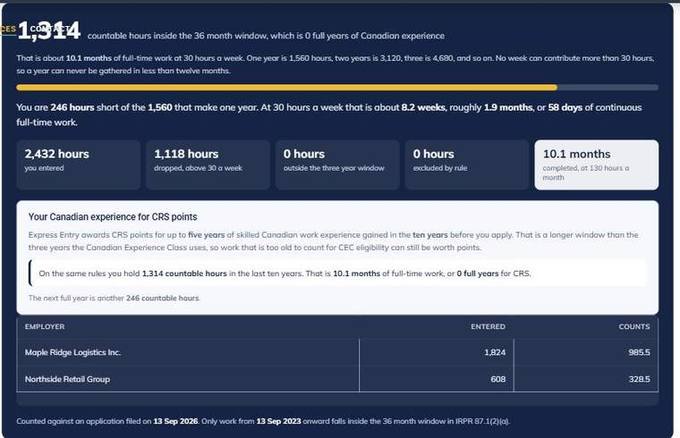
1,314 countable hours. One thousand one hundred and eighteen hours dropped for the weekly ceiling. Nothing lost to the window, nothing lost to an exclusion. Just the cap, applied 43 times.
And 1,314 is 246 hours short of a single year. At 30 hours a week that is 8.2 more weeks of work, about 1.9 months, or 58 days. An applicant who filed on the strength of 2,432 hours would be refused for not meeting the class requirement, holding two employment letters that both say full-time.
The six hour job
Now take the second employer out entirely and run the first job on its own.
Employer 1 alone, at 42 hours a week, produces 1,308 countable hours. Adding employer 2 back in, all 608 hours of it, moves the total from 1,308 to 1,314.
Six hours. Ten months of a real second job, properly documented and honestly reported, contributed six hours of CEC experience. It contributed them only because of the handful of part weeks at each end where the first job left a sliver of room under 30.
The calculator also shows how it attributes what survives: employer 1 keeps 985.5 hours of the 1,824 entered, employer 2 keeps 328.5 of 608. Where a week is over the ceiling, each employer’s share is scaled down proportionally, so the split stays honest rather than one job absorbing the whole loss. But the total is still 1,314, because the week only ever has 30 hours in it.
This is why “I had two jobs, so I got there faster” is the assumption we most often have to take apart, and why we would much rather take it apart before a file is submitted than after a refusal letter arrives.
The other four ways hours disappear
The weekly ceiling is the one that surprises people. These four are the ones that do real damage when they are discovered late, and they are per period rather than per job. A single job can have three good months and two that do not count.
Full-time study. Paragraph 87.1(3)(a) excludes any period of employment during which you were engaged in full-time study. Not reduced, excluded. You can work 40 hours a week throughout a full-time six month program and none of those six months counts, even on a post-graduation work permit. Note that being allowed to study on a work permit under the current temporary public policy is a separate question from whether the work underneath that study counts. The policy excuses the study permit. It does nothing about 87.1(3)(a). Part-time study does not trigger the exclusion, but the institution’s classification is what an officer reads, not your timetable.
Self-employment and unauthorized work. Paragraph 87.1(3)(b) removes both. Self-employed months can be entirely genuine skilled work and still be worth nothing to this class.
Any period without temporary resident status. Paragraph 87.1(3)(c) requires you to have held status throughout the experience you claim. A gap that was later restored does not retroactively become countable time.
Time physically outside Canada. The experience must be gained in Canada. Staying on the same payroll and working remotely from abroad for six weeks does not keep those six weeks in the count.
The calculator handles all four as column switches rather than as a blanket kill for the job. Tick the reason at employer level, then tick only the pay periods it actually covered, and only those drop to zero with the reason shown against them.
What the report gives you
The calculator emails you a PDF of the whole working, which is the part that matters when you are assembling a file rather than just satisfying curiosity. It is not a certificate and it carries no weight with IRCC. It is your own audit trail.
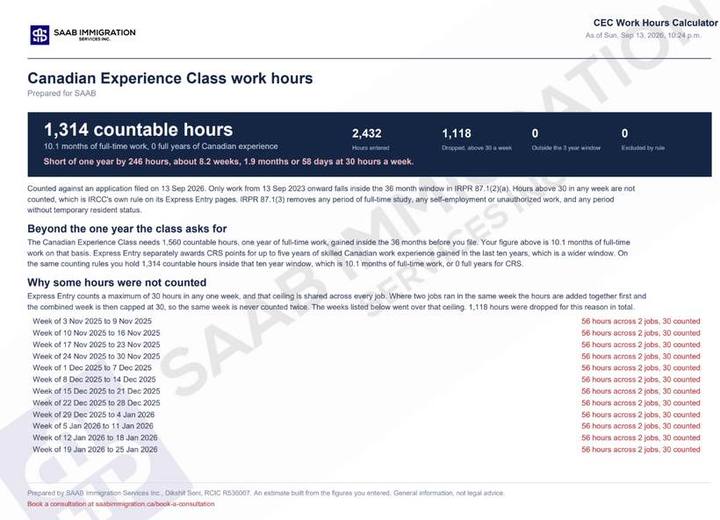
Page one carries the four headline figures, then the section titled “Why some hours were not counted”. That section lists the affected weeks individually, in the form “Week of 1 Sep 2025 to 7 Sep 2025, 56 hours across 2 jobs, 30 counted”. If you are 246 hours short, this is where you can see exactly which weeks took the hours and satisfy yourself that the arithmetic is right rather than taking a number on trust.
Later pages carry the per period table for every employer, the attribution split, and the wider CRS figure described next.
CRS is a wider window than CEC eligibility
One piece of good news, and it is regularly missed in the other direction.
Eligibility for the Canadian Experience Class looks back 36 months. The Comprehensive Ranking System does not. Express Entry awards points for up to five years of skilled Canadian work experience gained in the last ten years.
So work that has aged out of your CEC eligibility can still be earning you CRS points, and a fourth or fifth year of Canadian experience that does nothing for eligibility can still move your score. The calculator reports both totals from the same pay periods, because the answer to “am I eligible” and the answer to “what is my score” come from two different windows and people conflate them constantly.
Before you submit a CEC file
Three things, in order.
Run your actual pay periods, not your employment letters. Employment letters say “full-time, approximately 40 hours per week”. Pay stubs say what you were paid for, week by week, and the ceiling is applied to the week.
Run every job, including the small ones and the ones that overlapped. If a second job turns out to be worth six hours, that is worth knowing before you rely on it. Leaving it out of the calculation does not make the file weaker, but believing it carries three months that it does not is how a refusal happens.
Check the exclusions period by period. A course, a stretch of self-employment, six weeks abroad, or a status gap can remove months from the middle of an otherwise clean history, and the number that matters is what is left after all of it.
If you come out short, the question is not whether to file anyway. It is how many more weeks you need and what date that puts you on, because the 36 month window keeps moving while you wait. That is arithmetic, and it is what the calculator is for.
Does 1,560 hours mean I can finish in less than a year by working more hours?
No. Because hours above 30 in a week are discarded, 30 is the most any single week can contribute, so 1,560 countable hours cannot be reached in fewer than 52 weeks. The hour figure and the twelve month figure are the same requirement expressed two ways, not two separate routes.
I worked two jobs at the same time. Do both count?
Both are eligible work, and both belong in the application, but they share a single 30 hour weekly ceiling. In any week where your first job already reached 30 countable hours, the second job adds nothing to the total. It only contributes in weeks where the first job left room under 30.
My hours went up and down every week. Is that a problem?
It is the most common reason an applicant is short. Weeks over 30 are cut back to 30 and weeks under 30 count only what they were, with nothing carried across. So a history averaging 30 hours a week produces fewer than 1,560 countable hours, and the wider the swing, the larger the shortfall.
Do the hours have to be with one employer?
No. The one year can be put together across several employers and several occupations, provided each is TEER 0, 1, 2 or 3 and each period otherwise qualifies. The weekly ceiling still applies across all of them together.
I studied a short course while working. Does that stretch still count?
Not if the course was full-time. Paragraph 87.1(3)(a) excludes any period of employment during which you were engaged in full-time study, regardless of how many hours you worked. Part-time study does not trigger the exclusion, but full-time is decided by how the institution classifies the program, so get that classification in writing before you enrol.
Is the calculator’s number the number IRCC will use?
It applies the published rules to the figures you enter, so it is only as accurate as your pay periods. It is a preparation tool and an audit trail for your own file, not a determination. An officer assesses your evidence, and the classification of your occupation and the sufficiency of your proof are separate questions from the hour count.
What if I am short?
The calculator tells you the gap in hours, weeks, months and days at 30 hours a week, so you can work out a realistic filing date. Remember that the 36 month window moves with the filing date, so the oldest weeks of your experience drop out while you accumulate new ones. If you are close, the sequencing is worth planning rather than estimating.
Sources
- Immigration and Refugee Protection Regulations, section 87.1, Canadian Experience Class, including the one year requirement at 87.1(2)(a) and the exclusions at 87.1(3)
- IRCC, Canadian Experience Class, who can apply, including the statement that hours worked above 30 hours a week are not counted
- IRCC, program delivery instructions on qualifying work experience for the Canadian Experience Class
- IRCC, how Express Entry works, on the ten year lookback for Comprehensive Ranking System work experience points
