Hi, How Can We Help You?
  • Head Office: 5-2155 Dunwin Dr Mississauga ON L5L 4M1 Canada
  • Email Address: hello@saabimmigration.ca

Responding to a Procedural Fairness Letter

You Received a Procedural Fairness Letter. Here Is What It Means.

What this page covers

If your deadline is inside the next seven days, skip ahead and call us. Everything else on this page can wait until after that call.

A Procedural Fairness Letter, usually called a PFL, means an IRCC officer has a specific concern about your application and is required to give you the chance to answer it before deciding.

Read that again, because in the panic most people miss it. A PFL is not a refusal. It is the officer telling you in advance exactly what is about to sink your application, and giving you one opportunity to fix it.

It is also the last point at which the file can still be corrected rather than challenged. This is the most forgiving stage of the process. The officer is telling you what the problem is and inviting an answer, which is rarer than people assume. A weak response, a late response, or no response almost always produces a refusal, and depending on what the officer has raised, a finding that bars you from Canada for five years.

At SAAB Immigration we respond to procedural fairness letters constantly, across study permits, work permits, spousal sponsorship, Express Entry and permanent resident cases. We know what officers are looking for in an answer, because we have seen what satisfies them and what does not.

Check your deadline before you read any further. Your letter states how many days you have, commonly 7, 10, 15 or 30, and the clock generally runs from the date on the letter rather than the day you opened it. If your deadline falls inside the next week, call us now on +1 (877) 683-7222.

Have You Received a Procedural Fairness Letter?

A procedural fairness letter is not a refusal. It is the one opportunity to answer the officer’s concern before a decision is made, and the response window is short. SAAB Immigration Services Inc. offers a complimentary ten minute consultation to assess what is actually being put to you. There is no obligation.

Why Did IRCC Send You a PFL?

Officers issue a procedural fairness letter when they are looking at something that would lead them to refuse, and fairness requires that you get to answer it first. The concern is usually one of these:

  • Suspected misrepresentation
    a document the officer believes may not be genuine, an inconsistency between what you declared and what they found, or an omission such as an undeclared family member, a prior refusal, or an earlier application under a different name.
  • Document authenticity
    employment letters, bank statements, educational credentials or language test results the officer wants independently verified.
  • Genuineness of a relationship
    in spousal and common-law sponsorship, a concern that the relationship was entered into primarily for immigration purposes.
  • Job offer or LMIA concerns
    doubts about whether the employer is legitimate, the position genuine, or the wage accurate.
  • Inadmissibility
    criminality, medical inadmissibility, security concerns, or an issue arising from a family member.
  • Study plan and intent
    a concern that you will not leave Canada at the end of your authorised stay, or that the programme does not fit your background.
  • Full time study and active enrolment
    IRCC suspects you are not actively pursuing your studies. Attendance dropped, you fell below a full time course load, you took an unauthorised leave, or you are enrolled on paper but not genuinely studying. This very often surfaces when you later apply for a PGWP or an extension.
  • Residency obligation
    for permanent residents, days physically present in Canada falling short of what is required.

Your letter will identify which one applies. Everything about a successful response depends on answering that specific concern, with evidence, rather than re-explaining your application in general terms.
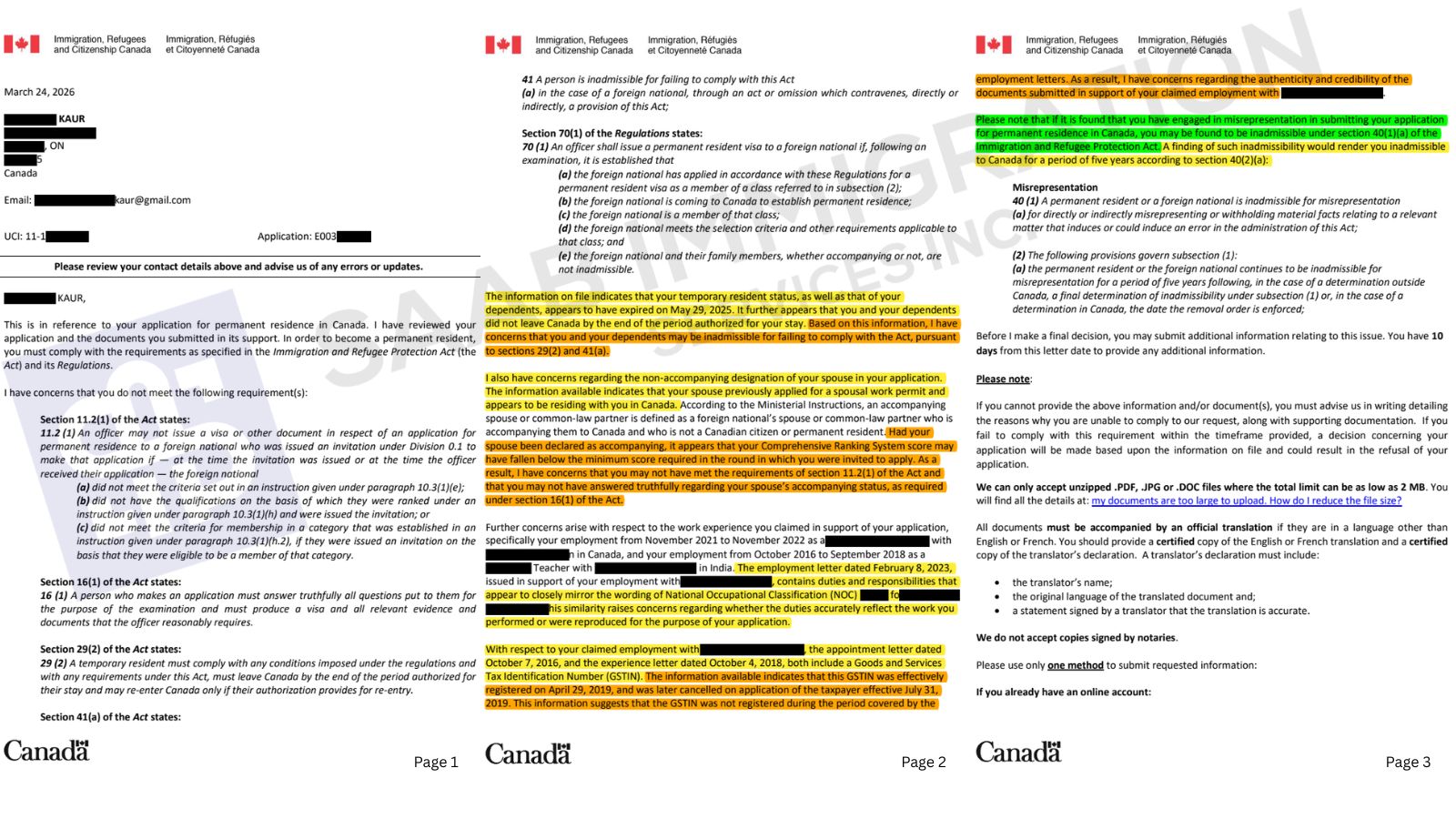
Example of a procedural fairness letter issued by IRCC
An example of a procedural fairness letter. Yours will name a specific concern and state a deadline. Both matter, and the deadline runs from the date on the letter.

If Your Letter Mentions Misrepresentation, Do Not Answer It Alone

Every procedural fairness letter is serious. A misrepresentation procedural fairness letter is in a category of its own.

Under section 40 of the Immigration and Refugee Protection Act, a finding of misrepresentation under section 40 of IRPA makes you inadmissible to Canada and carries a five year bar on applying. It attaches to you personally rather than to the application. It follows you into every future application, it has to be disclosed, and some countries share this information.

Misrepresentation also does not require that you intended to deceive. Innocent errors, omissions made on an agent’s advice, and mistakes you did not personally make can still support a finding if the officer concludes they could have induced an error in the administration of the Act. Saying that your agent completed the forms is not on its own an answer, although how the error happened is often central to the response.

A response that works addresses materiality, addresses intent, proves the true facts with documents, and where there was an error explains it credibly instead of denying it. This is precise work, and the cost of getting it wrong is five years of your life.

What Does a Strong PFL Response Look Like?

A response is a submission, not a form. There is no template that works, because the entire exercise is answering one officer’s one concern. Strong responses share a structure:

  • Answer the concern in the first paragraph
    officers read hundreds of these. Do not bury your answer under background.
  • Provide evidence, not assurances
    if the officer doubts your employment letter, send payroll records, tax filings, a corporate registry extract, and a named contact who will verify it. Stating that the letter is genuine adds nothing.
  • Explain discrepancies instead of avoiding them
    if something is inconsistent, name it and account for it. Officers notice what you step around.
  • Address the legal test
    for misrepresentation that means materiality. For relationship genuineness it means the factors set out in the Regulations.
  • Index your evidence clearly
    so the officer can find what you have sent without hunting for it.
  • Follow the format and channel the letter specifies
    exactly as stated, and inside the deadline.

Audit your whole profile, not only the concern in the letter. A PFL names the concern that reached the officer’s desk. It does not tell you that everything else in your file is fine. Once an officer begins examining an application, the review rarely stops at one line. Before you respond, go back through every application you have filed, in Canada and elsewhere, and find anything that could become the next question. Then decide deliberately what to address pre-emptively and what to leave alone. That judgement is strategy, and it is where most self-prepared responses come undone.

Here is how it goes wrong in practice. The most common instinct on receiving a misrepresentation PFL is to say: I did not do this, my agent or consultant must have submitted it. It feels like the safe answer. But if that agent was never disclosed on your application as your representative, you have just told IRCC that you used an undisclosed representative, and failing to disclose a representative is itself a ground of misrepresentation. You have answered one allegation by handing the officer a second one. We see this happen again and again.

A procedural fairness letter is not a one time event. Nothing limits IRCC to a single letter. The one you have addresses one concern. Answering it properly does not prevent a second letter being issued on a different ground, and a second letter can be triggered by something your own response put on the record.

The point is not that you should conceal who prepared your application.

What sinks responses: resending the same documents the officer already doubts, appeals to how much this means to your family, blaming an agent without proof, missing the deadline, and answering a question the officer did not ask.

What Happens If You Do Not Respond?

If you do not answer the procedural fairness letter, the officer decides on the record already in front of them, which is the record that concerned them in the first place. In practice that means refusal.

It also closes doors you may want later. If you are refused after failing to answer a PFL, you cannot credibly argue at the Federal Court that you were denied procedural fairness, because you were given it and did not use it. The procedural fairness letter is the fairness. Once it has been offered, that argument is gone.

This is why the PFL stage is the single best opportunity in your file to change the outcome. Answering it properly now is faster, simpler and far more likely to succeed than challenging a refusal at the Federal Court later.

How Do We Handle Your PFL Response?

  1. We start with the letter and your file, not a template.
    We read precisely what the officer alleges, then read your original application to find what triggered it. Very often the concern comes from something the applicant never realized was in the file at all.
  2. We obtain the GCMS notes where time allows.
    The notes usually reveal more of the officer’s thinking than the letter does. Where the deadline is short, we respond first and request the notes in parallel.
  3. We build the evidence package.
    This is the bulk of the work: identifying what would actually satisfy the officer’s concern, and obtaining it in a form they will accept, inside your deadline.
  4. We write submissions that engage the legal test.
    Not a letter explaining that you are a good person, but a submission addressing materiality, intent, genuineness, or whichever test governs your case.
  5. We ground the submission in the case law.
    Where the Federal Court has already decided the issue in front of you, whether that is what makes an omission material, what an officer is required to put to you, or when a concern is not reasonably held, we say so and we cite it. A submission that engages with settled law reads differently from one that only asserts.
  6. We tell you honestly where you stand.
    Some procedural fairness letters are highly answerable. Some are not. You will know which one you have before you commit to anything.

You can read how this plays out on real files in our case studies, including a 16 year old spousal sponsorship refusal we overturned, a PGWP restoration granted after loss of status, and the five mistakes that most often lead to study permit and PGWP refusals.

Dikshit Soni, RCIC (R536007) acts as your authorized representative for the response. If your matter later needs the Federal Court, it is handled by Dr. Pallavi Kataria of Pallavi Law Office, and we stay on the file alongside her.

Send us the letter today. We will tell you what the officer is actually alleging, what evidence would answer it, and whether your case is winnable, before you commit to anything.

The information on this page is general information about Canadian immigration law and procedure. It is not legal advice and does not create a consultant-client or solicitor-client relationship. Deadlines and outcomes depend on the facts of your individual case.

Frequently Asked Questions

Is a procedural fairness letter the same as a refusal?
No. A procedural fairness letter means the officer has a concern and has not yet decided. You still have the opportunity to change the outcome. A refusal letter communicates a decision that has already been made.
How long do I have to respond to a PFL?
Your letter states the deadline and it varies, commonly 7, 10, 15 or 30 days. The clock generally runs from the date on the letter rather than the date you saw it, so check immediately. Some letters allow you to request an extension, but you must ask before the deadline passes and give a reason.
Can I ask IRCC for more time?
Sometimes. If you need documents from a bank, a university or a foreign government, a short reasoned extension request filed before the deadline is often granted. It is never guaranteed. Never assume an extension and never allow the deadline to pass while waiting for an answer.
What happens if IRCC finds misrepresentation?
Under section 40 of IRPA you become inadmissible to Canada and are generally barred from applying for five years. The finding attaches to you personally and must be disclosed on future applications. This is why a misrepresentation PFL should never be answered casually.
My agent made the mistake, not me. Does that help?
It is relevant but it is not a complete answer on its own. Applicants are generally responsible for the accuracy of what is submitted on their behalf. How the error arose, whether you knew about it, and whether you acted promptly once you discovered it all matter. Keep every record of your dealings with that agent.
Can I respond to a PFL myself?
You are entitled to. Whether you should depends entirely on the concern raised. A request to verify a bank statement may be manageable alone. A misrepresentation allegation, a relationship genuineness concern or an inadmissibility issue carries consequences measured in years, and the response is a legal submission rather than a letter. Those are the ones to bring to us.
Should I withdraw my application instead of responding?
Occasionally withdrawal is the right strategy, particularly where a misrepresentation finding looks likely and withdrawing may avoid it. It is a case specific judgement with serious consequences and should not be made without advice. Withdrawing does not always prevent a finding.
Will responding to a PFL delay my application?
Usually by some weeks or months while the officer considers your submission. That delay is worth having. The alternative is a faster refusal.
I was refused after responding to a PFL. What now?
Request your GCMS notes to see how the officer treated your response. Depending on what they show, your options may include reconsideration, an appeal if you have appeal rights, judicial review at the Federal Court, or a properly rebuilt application. Our refusals and appeals page sets out how these compare.
Do PFLs apply to permanent residents and citizenship applicants?
Yes. Permanent residents commonly receive them on residency obligation and inadmissibility issues, and citizenship applicants receive them on residence, prohibitions and misrepresentation concerns. The principle is the same. The decision maker must put the concern to you before deciding against you.

Discuss Your Procedural Fairness Response With a Regulated Professional

Deadlines in these letters are short, and they are not extended because you were busy or waiting on a document. If yours is live, the useful next step is a conversation today rather than next week.

Meet our Team


Related Pages

Other pages on this site that deal with closely connected questions.