

- Section 215 of the Regulations is a closed list. If you are not on it on the day you apply, your in-Canada study permit application fails on eligibility, whatever the school, the funds or the study plan look like.
- The paragraphs that matter to most people are written in the present tense. Hold a study permit. Hold a work permit. Held one last month is not the same thing.
- Restoration is not a bridge to a different permit. Section 182 restores the status you lost. IRCC says it plainly: restore your initial permit and status first, then apply for something different.
- A letter of acceptance from a designated learning institution is not a status document, and admission does not create eligibility to apply.
- R215(2)(b) gets overlooked. The family member of a person who holds a work permit may apply from inside Canada, and there is no TEER, NOC or occupation test anywhere in it.
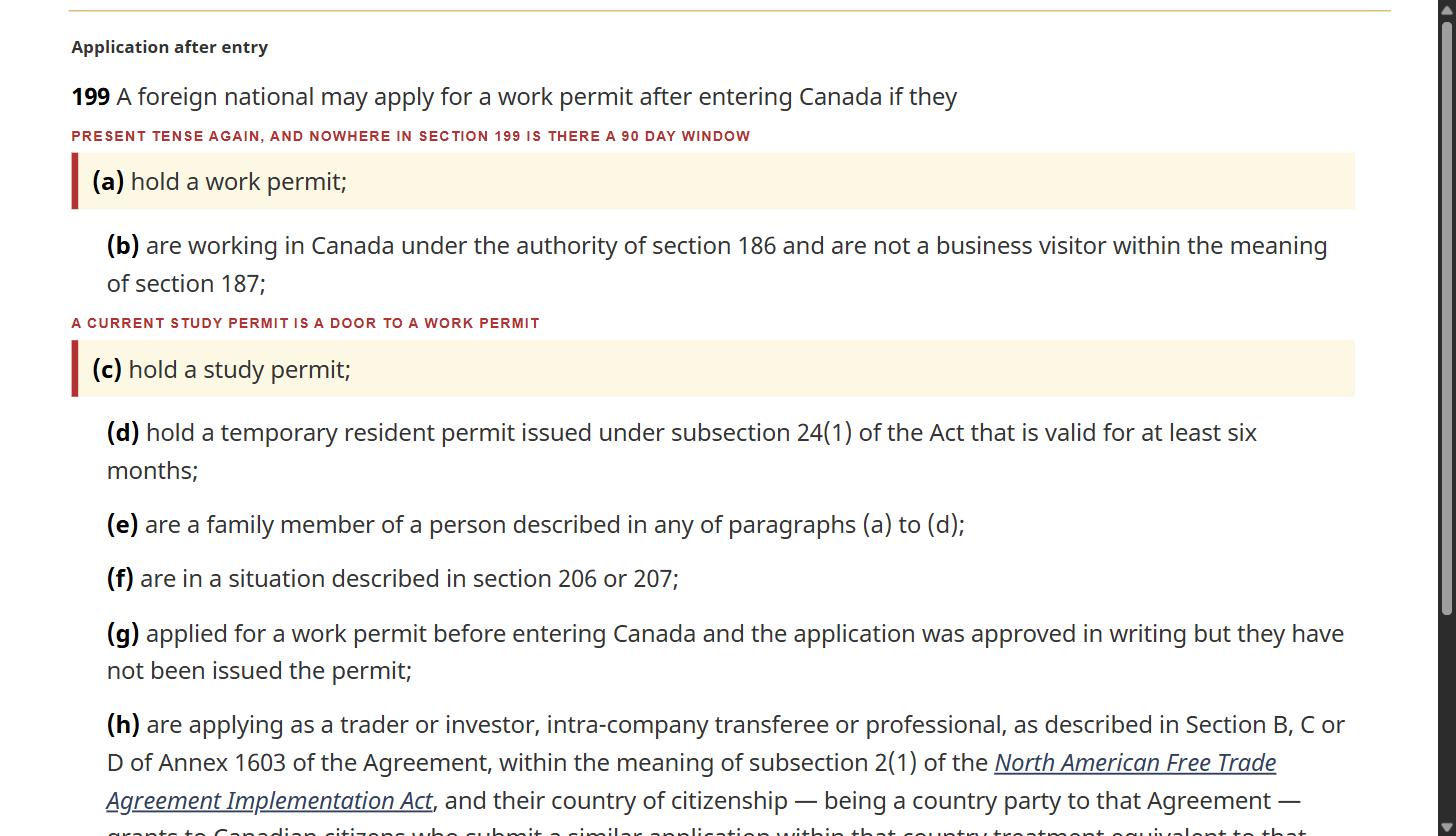
- The same structure governs work permits under section 199, and section 199 has no 90 day window at all.
Sam’s work permit was employer specific and it was running out. His LMIA was in process, his provincial nomination was in process, and neither was going to land in time. So he did the sensible looking thing. He filed a work permit extension before the permit expired, and stated honestly that he would stop working when the current permit ran out. That put him on maintained status while the application sat in the queue.
The extension was refused. No LMIA, no nomination, no new job offer, so there was nothing to extend. On the day of that refusal Sam’s maintained status ended and he had no status at all.
Then he was told what a lot of people in this position get told. Get a letter of acceptance from a designated learning institution, file a study permit from inside Canada, and that puts your status back. He did it. It was refused, and the refusal had nothing to do with the school, the funds or the study plan. He was never eligible to file it.
Sam is a composite, not a client. I see this file several times a month, and almost always after somebody has already told the applicant it would work.
Section 181, and why the filing date decides it
Before anyone gets to section 215, there is an earlier gate, and it is the one I see refusals on most often. It decides whether you were even allowed to file the extension in the first place.
181 (1) A foreign national may apply for an extension of their authorization to remain in Canada as a temporary resident if
(a) the application is made by the end of the period authorized for their stay; and
(b) they have complied with all conditions imposed on their entry into Canada.
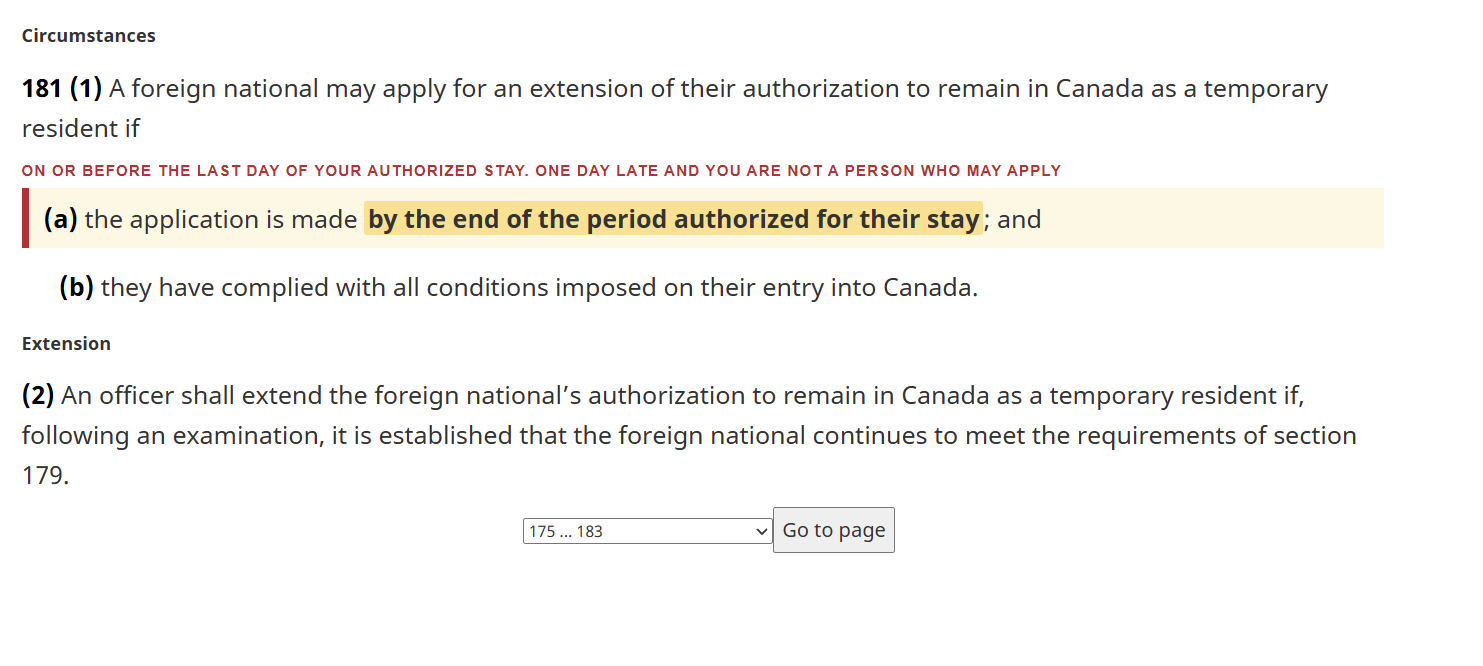
Paragraph (a) is a date. There is no reasonableness test in it, no discretion and no room for a good explanation. A refusal I am looking at this week makes the point better than I can: status as a worker expired on 6 August, the study permit extension was filed on 16 August, and the officer refused it because the applicant applied while out of status, citing R181(1). Ten days.
The same letter carries a second finding, and it is the one that sends people to me. The officer wrote that the applicant “is not a person described in Immigration Legislation who can apply for this type of document from within Canada”, and that an application of this type “must be made at a Canadian Visa office in another country”. That is section 215 in plain English, written by the officer rather than by me, and it is what the rest of this piece is about.
What section 215 actually says
Everything here turns on one provision, so read it rather than a paraphrase of it. Section 215 of the Immigration and Refugee Protection Regulations governs who may apply for a study permit after entering Canada.
215 (1) A foreign national may apply for a study permit after entering Canada if they
(a) hold a study permit;
(b) apply within the period beginning 90 days before the expiry of their authorization to engage in studies in Canada under subsection 30(2) of the Act, or paragraph 188(1)(a) of these Regulations, and ending 90 days after that expiry;
(c) hold a work permit;
(d) are subject to an unenforceable removal order;
(e) hold a temporary resident permit issued under subsection 24(1) of the Act that is valid for at least six months;
(f) are a temporary resident who (i) is studying at the preschool, primary or secondary level, (ii) is a visiting or exchange student who is studying at a designated learning institution, or (iii) has completed a course or program of study that is a prerequisite to their enrolling at a designated learning institution; or
(g) are in a situation described in section 207.
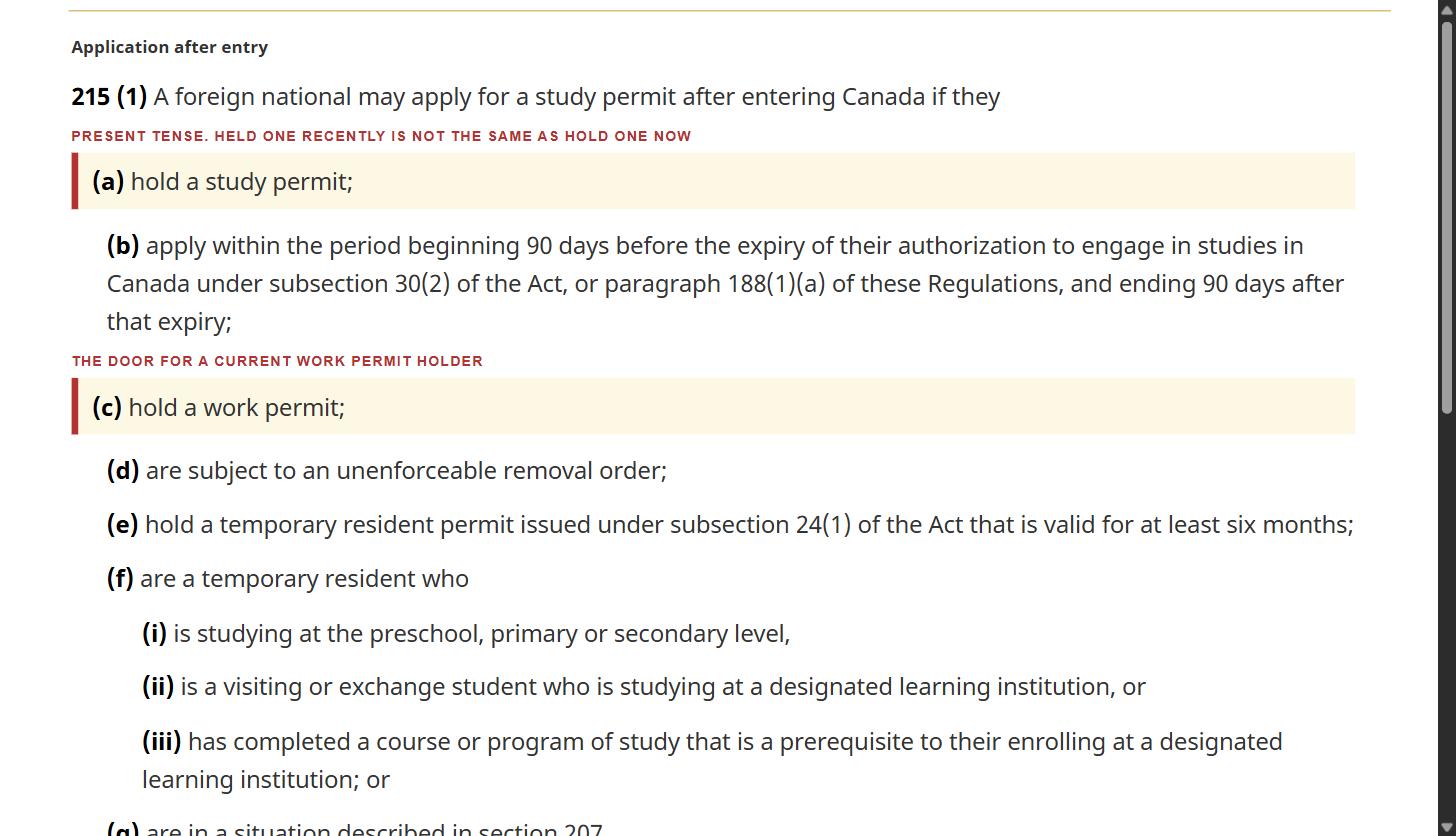
Read paragraphs (a) and (c) again. Hold a study permit. Hold a work permit. Not held, not recently held, not applied to extend. The provision asks what you hold on the day you apply, and nothing in the list describes a person who used to hold a permit and does not now.
There is a 90 day window in the list, at paragraph (b), and it is the most misread part of the section. It does not attach to a study permit. It attaches to the expiry of an authorization to study under subsection 30(2) of the Act, which authorises a minor child in Canada to attend preschool, primary or secondary school, or under paragraph 188(1)(a), the family and private staff of an accredited foreign representative. Those are the two groups who study here without a permit. Hold an actual study permit and you are in paragraph (a), which has no window.
Restoration gives back the status you lost
The assumption that causes the most damage is a reasonable one. People know restoration exists, they know about the ninety days, and they assume that if restoring to a work permit fails they can move across into study instead. The wording shows why that fails.
182 (1) On application made by a visitor, worker or student within 90 days after losing temporary resident status as a result of failing to comply with a condition imposed under paragraph 185(a), any of subparagraphs 185(b)(i) to (iii) or paragraph 185(c), an officer shall restore that status if, following an examination, it is established that the visitor, worker or student meets the initial requirements for their stay…
An officer shall restore that status. The one that was lost. Sam lost worker status, so restoration is a route back to worker, or across to visitor, conditioned on meeting the initial requirements for that stay. It is not a mechanism for becoming a student. IRCC says the same on its own restoration page without hedging: “If your permit and status have expired, you must restore your initial permit and status first. After that, you can apply for a different permit.” The order is fixed. Status first, then the new permit, not the new permit as a way of fixing the status.
“Restoration gives back the status you lost. Nothing more.”
If any of this describes where you are, the order you do things in from here decides what is still available afterwards. Bring us the permit dates and let us go through your situation properly.
The extension filed only to hold status
There is a habit of filing a work permit extension nobody expects to be approved, on the theory that it parks the status while something better is arranged. It buys less than people think.
Filed on time, R183(5) extends the authorized period until a decision and R183(6) confirms status is kept meanwhile. Filed a day late, and as section 181 above shows, none of it engages.
What that period does and does not let you apply for turns on the facts of your own file. It is not something to work out from a blog post, and it is certainly not something to work out from what somebody says worked for them. Have it looked at before you file anything.
The one thing that is not in doubt is the timing. When the extension is refused, the period ends that day, and so does anything that rested on it.
And from IRCC’s port of entry guidance, for anyone thinking a quick trip resets things: “If you leave Canada as a worker on maintained status, you’ll lose your ability to work when you return.”
What R215(2) does for a spouse or child
Section 215 has a second subsection. It looks at somebody else’s permit instead of your own, and it is regularly overlooked.
215 (2) A family member of a foreign national may apply for a study permit after entering Canada if the foreign national resides in Canada and the foreign national
(a) holds a study permit;
(b) holds a work permit;
(c) holds a temporary resident permit issued under subsection 24(1) of the Act that is valid for at least six months;
(d) is subject to an unenforceable removal order; …
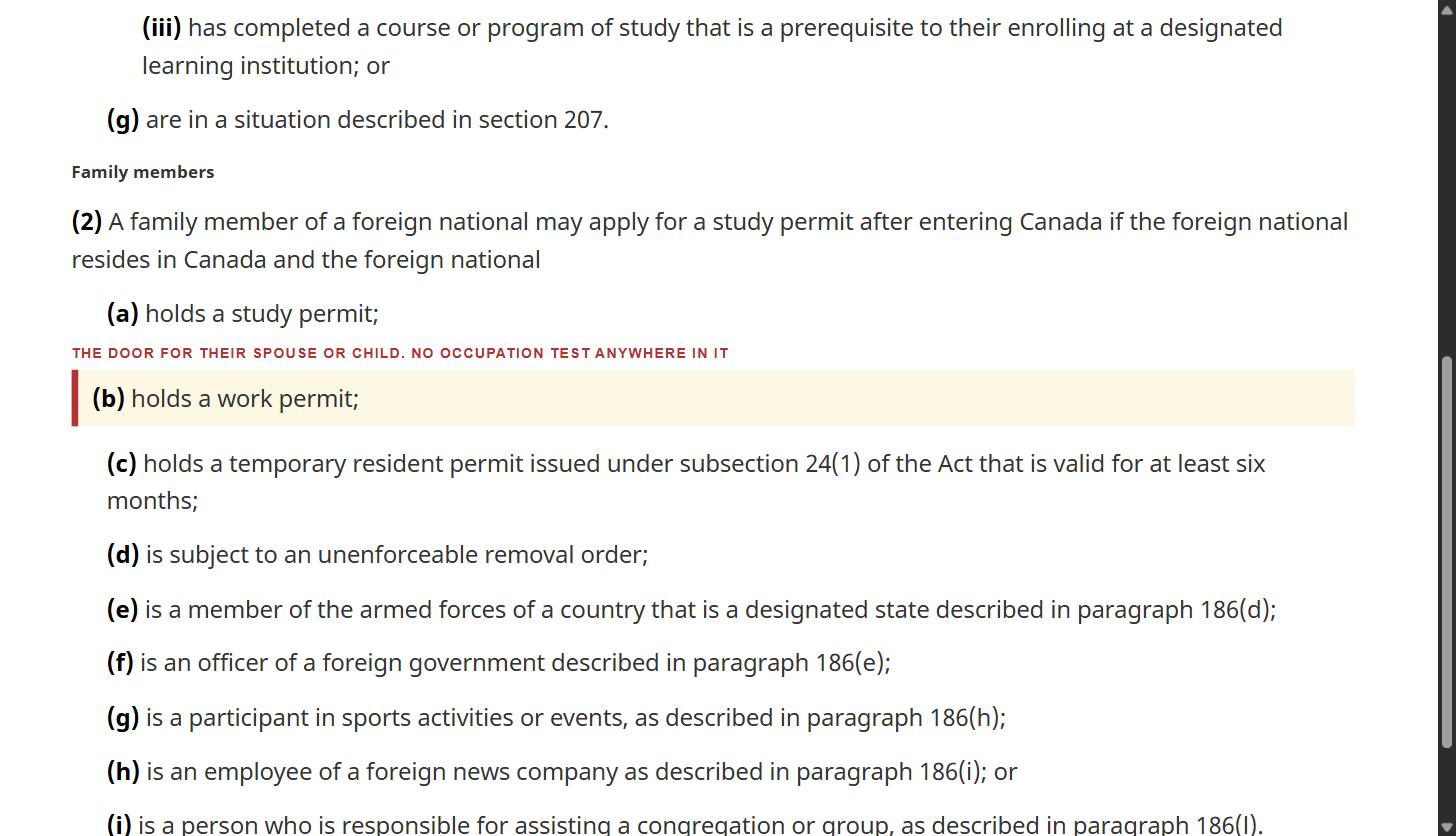
Paragraph (b) says nothing about occupation. No TEER category, no NOC code, no wage floor, no list. The principal has to hold a work permit and reside in Canada, and that is all it asks.
That matters more in 2026 than it did, because the open work permit rules changed and this provision did not. Since 21 January 2025 an open work permit for a worker’s spouse is limited to principals in TEER 0 or TEER 1, or a named list of TEER 2 and TEER 3 occupations, and dependent children came off the measure entirely. Most food service and hospitality work sits in TEER 4 and TEER 5, outside it. So a spouse can be plainly ineligible for an open work permit and still sit squarely inside R215(2)(b) for a study permit. They are two separate provisions. A restriction on one says nothing about the other.
Because R215(2) is keyed to the principal’s permit rather than the applicant’s own status, a family member inside the 90 day restoration window is in a different position from the principal worker, who can no longer rely on R215(1)(c). It is narrow and it turns on the facts, but it is real, and worth checking before anyone concludes nothing is left.
If you are here on a visitor record, you are not automatically shut out
Most visitors cannot apply for a study permit from inside Canada, and that is the honest starting point. A visitor record is not a study permit and it is not a work permit, so it does not put you on the main list. But there is a real way in at paragraph (f), and it gets missed as often as the family member one.
215 (1) A foreign national may apply for a study permit after entering Canada if they
(f) are a temporary resident who
(i) is studying at the preschool, primary or secondary level,
(ii) is a visiting or exchange student who is studying at a designated learning institution, or
(iii) has completed a course or program of study that is a prerequisite to their enrolling at a designated learning institution
Notice the words at the top of (f): a temporary resident. Not a permit holder. A visitor is a temporary resident, so a visitor can be inside this paragraph. Three plain examples of how that happens.
Your child is at school here. A minor child in Canada is authorised to attend preschool, primary or secondary school under subsection 30(2) of the Act. That child falls in (f)(i).
You came on an exchange term. If you are a visiting or exchange student studying at a designated learning institution, that is (f)(ii).
You finished a prerequisite course. This is the one people actually use, so read it twice. Under R188(1)(c) you may study in Canada without a permit if the course is six months or less and finishes inside your authorised stay. So a visitor can arrive, complete a short course that the college requires before the main programme, and then be a person who “has completed a course or program of study that is a prerequisite to their enrolling at a designated learning institution”. That is (f)(iii), and at that point you may apply from inside Canada.
The practical version: the prerequisite has to be genuine and it has to be finished. A course you invent to buy an argument is not a prerequisite, and a course you are still in the middle of has not been completed.
Being allowed to apply is not the same as getting the permit
This is where visitor applications are actually decided, and it is worth separating the two questions. Section 215 decides whether you may apply. Section 216 decides whether the permit is issued.
216 (1) Subject to subsections (2) and (3), an officer shall issue a study permit to a foreign national if, following an examination, it is established that the foreign national
(a) applied for it in accordance with this Part;
(b) will leave Canada by the end of the period authorized for their stay under Division 2 of Part 9;
(c) meets the requirements of this Part; …
Two things follow from that. Paragraph (a) loops back to section 215, so if you were not eligible to apply, you fail here as well. And paragraph (b) is the one that decides most of these files, because the officer has to be satisfied you will leave at the end of your stay. That assessment is not routinely kind where you are applying to convert visitor status into a study permit. It is answered with documents and a coherent plan, not with a strong letter of acceptance.
One line on the form that causes real damage
I see this go wrong often enough to say it plainly. If you are physically in Canada and you enter a country of residence other than Canada, to make the application look like it was made from outside, you are creating future grounds of misrepresentation. It is a statement about a material fact on a relevant matter.
40 (1) A permanent resident or a foreign national is inadmissible for misrepresentation
(a) for directly or indirectly misrepresenting or withholding material facts relating to a relevant matter that induces or could induce an error in the administration of this Act;
An approval does not close that off. Misrepresentation can be found later, on a different application, and subsection 40(2)(a) carries the inadmissibility for five years, running from the final determination if it is made outside Canada or from the day a removal order is enforced if it is made in Canada. A study permit obtained that way is not a solution, it is a five year problem waiting on a shelf.
So answer the residence question with where you actually are. If you are in Canada and you are not on the section 215 list, the answer is not to relabel the application. The answer is to leave and apply properly from outside.
Check your own situation
The answer changes with what you hold on the day you apply, so the tool below is organised by that rather than by what you want to do.
In-Canada study permit: are you eligible to apply?
Built from section 215 of the Regulations. Eligibility to apply only, not an assessment of your application.
- A valid work permit, not yet expired R215(1)(c). You are inside the provision, and the permit date is your deadline.
- A valid study permit, not yet expired R215(1)(a). You may apply for a new study permit, and for a work permit.
- A temporary resident permit valid for at least six months R215(1)(e) and R199(d). A TRP of six months or more works for both permits.
- My work permit expired, I filed the extension before it expired, and I am still waiting R183(5), R183(6), R215(1)(c). You have status, but whether you hold a permit is a live question.
- My work permit expired and my extension was refused R182, and no paragraph of R215(1). You cannot apply, and the ninety days is running.
- My permit expired and I never applied for anything R182, and no paragraph of R215(1). Same answer, and the clock started earlier.
- I am the spouse or child of someone in Canada who holds a work permit R215(2)(b). Regularly overlooked, and there is no occupation test in it.
- I am the spouse or child of someone in Canada who holds a study permit R215(2)(a). It depends on their permit, not on your own status.
- I am subject to a removal order that cannot be enforced R215(1)(d). An unenforceable removal order is a listed category.
Section 199 does the same thing for work permits
This is not peculiar to study permits. Section 199 is the equivalent provision for work permits. It lists people who hold a work permit, who hold a study permit, who are working under section 186 without being a business visitor, who hold a TRP valid for at least six months, family members of those people, people in a situation described in section 206 or 207, and a few narrow trade agreement and foreign mission categories. Same present tense, and unlike section 215 there is no 90 day window in it anywhere.
Driving to the border no longer fixes a permit problem either. Flagpoling for work and study permits ended on 23 December 2024 at 11:59 pm Eastern, with a short exceptions list covering US citizens and lawful permanent residents, certain free trade agreement professionals and their spouses, international truck drivers, and people with a pre-booked CBSA appointment. For everyone else it goes to IRCC, from inside Canada, under the provisions above.
Section 25 is not the answer, and a TRP might be
Humanitarian and compassionate relief is the next thing people reach for and it does not reach this problem. Subsection 25(1) operates “on request of a foreign national in Canada who applies for permanent resident status”. It is a permanent residence mechanism and it cannot be attached to a study permit, a work permit or a restoration application.
The temporary equivalent is a temporary resident permit under subsection 24(1), and one detail matters here. A TRP valid for at least six months is a listed category in both R215(1)(e) and R199(d), so it works for both. It is also discretionary, issued where an officer considers it justified in the circumstances, and rarely the right answer while restoration is available. A fallback that exists, not a plan.
What to do instead
The rule is simple. Check the permit before you check the college.
If you are outside your work permit, outside maintained status and outside your study permit, do not file an in-Canada study permit application on the strength of an acceptance letter. You are not eligible to apply, the fee does not change that, and a refusal on eligibility is a worse starting point than never having applied. Deal with status first, on its own terms.
If your permit is still valid this is a timing exercise, and the date on the permit is the deadline. If an extension is pending, know exactly what it holds and what a refusal does to it. If your status has lapsed the ninety days is running, and the order you do things in decides what is left afterwards.
And if you are already outside all of it, do not assume that is the end of the road. It usually is not. The next section is the part I spend most of my time on.
I see this advised badly and often, including by people who should have read the provision. If someone tells you a college admission will fix your status, ask them which paragraph of section 215 you fall under. If they cannot name one, they have not read it.
If you are not on the list, here is what actually works
This is the part I care about most, because people arrive at my office convinced they are stuck, and usually they are not stuck. They are just looking in the wrong place.
Go back and read the first line of section 215. It governs a foreign national who applies after entering Canada. That is the whole scope of it. It says nothing at all about an application made from outside Canada, because that application is assessed under different provisions entirely.
So if no paragraph of section 215 describes you, the route that works is to leave Canada and apply for the study permit from outside. I want to be clear that this is not a punishment and it is not a last resort. It is the application the Regulations expect from someone in your position, and it gets assessed on whether you are a genuine student with the money to study, which is a question you can actually answer with documents. An in-Canada application from someone who is not on the list never reaches that question. It fails before anyone looks at the school.
Before you book anything, two things have to be sorted out, and this is the order I do them in.
First, do not expect restoration to make you a student. Section 182 gives back the status you lost, within ninety days, and nothing further. If you were a worker, restoration is a route back to worker status, or a change to visitor. It has never been a way to become a student. And once the ninety days has gone, restoration is not on the table at all.
Second, read section 221 before you file from anywhere. This is the one that catches people, and it is the reason I ask about unauthorised work before I ask about the college.
221 Despite Division 2, a study permit shall not be issued to a foreign national who has engaged in unauthorized work or study in Canada or who has failed to comply with a condition of a permit unless
(a) a period of six months has elapsed since the cessation of the unauthorized work or study or failure to comply with a condition;
(b) the work or study was unauthorized by reason only that the foreign national did not comply with conditions imposed under paragraph 185(a), any of subparagraphs 185(b)(i) to (iii) or paragraph 185(c); or
(c) the foreign national was subsequently issued a temporary resident permit under subsection 24(1) of the Act.
Read what that says: the permit shall not be issued. Not shall not be applied for. So it bites wherever you file, and getting on a plane does not reset it. If you kept working after your permit expired and you had no authorisation to do so, the six months in paragraph (a) runs from the day you stopped, not from the day you leave. Paragraph (b) is a real carve out and it is worth checking your facts against it rather than assuming the worst, and paragraph (c) is the temporary resident permit route.
Put those together and the plan for most people in Sam’s position is short. Work out the exact date status was lost and whether any unauthorised work or study happened. Stop anything that is unauthorised, today, because the six months only starts running once it has stopped. If the ninety days is still open and you want to stay, restore to what you had. If you want to study, plan the application from outside Canada and time it around section 221. Then build the study permit application properly, because once you are applying from outside, the only thing standing between you and a permit is the merits.
One exception worth knowing: section 207
There is a relief valve in section 215 and it is easy to read past, because it does not ask what you hold. Paragraph R215(1)(g) covers anyone who is “in a situation described in section 207”, and section 207 is about your situation rather than your paperwork.
207 A work permit may be issued under section 200 to a foreign national in Canada who
(b) is a member of the spouse or common-law partner in Canada class set out in Division 2 of Part 7;
(c) is a protected person within the meaning of subsection 95(2) of the Act;
(d) has applied to become a permanent resident and the Minister has granted them an exemption under subsection 25(1), 25.1(1) or 25.2(1) of the Act; or
(e) is a family member of a person described in any of paragraphs (a) to (d).
Be realistic about which of these is available. Paragraph (c) is a different situation altogether. Paragraph (d) needs the Minister to have already granted an H&C exemption, which means a first stage approval, and that is years rather than an answer to a permit expiring next month. Paragraph (e) only inherits from the others.
The one that does real work is (b), the spouse or common-law partner in Canada class. And there is a step here that is not obvious from section 207 at all. Class membership is set by section 124: you are a member if you are the spouse or common-law partner of a sponsor and cohabit with them in Canada, you have temporary resident status in Canada, and you are the subject of a sponsorship application. On its face, that status requirement excludes exactly the person we have been talking about.
It does not, because of a public policy under subsection 25(1) of the Act. In its own words, “the effect of the policy is to exempt applicants from the requirement under R124(b) to be in status.”
So the chain runs like this. Out of status, married to or in a common-law relationship with a Canadian citizen or permanent resident, cohabiting in Canada, and an inland sponsorship filed. The public policy waives the status requirement at R124(b), so you are a member of the class. Membership of that class is a situation described in section 207. And R215(1)(g) reaches anyone in a situation described in section 207. A study permit application from inside Canada, with no permit in hand. R199(f) does the same thing for a work permit.
Four limits, and I would not raise this with anyone without going through all four. Section 207 says a work permit may be issued, so it is permissive and not automatic. The sponsorship application has to actually be filed, because membership of the class depends on it. The public policy has hard carve outs: it does not carry a person already under a removal order through to final approval, it excludes those who used fraudulent or improperly obtained travel documents, and criminality and security under sections 34 to 37 of the Act are expressly not waived. And section 221 still sits behind all of it, so unauthorised work still costs six months.
The practical reading is short. If you are single and your work permit has gone, R215(1)(g) is an empty box. If you have a Canadian spouse or partner, it can be the difference between leaving and staying, and almost nobody finds it, because you have to read four separate things to get there.
Frequently asked questions
The questions below are the ones we are actually asked about this provision, in the order they usually arrive.
My work permit has expired. Can I apply for a study permit from inside Canada?
On the face of section 215, no. The paragraphs that would cover you are written in the present tense: hold a study permit, hold a work permit, hold a temporary resident permit valid for at least six months. An expired work permit is none of those. Unless another paragraph of R215(1) describes you, such as being subject to an unenforceable removal order or being in a situation described in section 207, you are not eligible to make the application, and the strength of the rest of the file does not enter into it.
I am not eligible to apply from inside Canada. Does that mean I cannot study in Canada?
No, and this is the part people get wrong in the other direction. Section 215 only governs applications made after entering Canada. An application made from outside Canada is not caught by it at all. So for most people in this position the answer is to leave and apply from outside, where the application is judged on whether you are a genuine student who can fund the studies rather than being refused on eligibility. Two things to check first. Restoration will not make you a student, it only gives back the status you lost and only within ninety days. And section 221 says a study permit shall not be issued to someone who has worked or studied without authorisation, or breached a permit condition, until six months have passed since that stopped, subject to two narrow exceptions. That bar applies wherever you file, so leaving Canada does not reset it.
My extension is still pending and I am on maintained status. Can I apply now?
Do not decide this from a web page. Your permit has expired and an application is sitting in the queue, and what you are eligible to apply for from inside Canada in that window turns on the facts of your file and on what was actually submitted. This is the point to get advice, not after. What is not in doubt is the timing: if the extension is refused, the period ends that day and anything resting on it ends with it. And if you leave Canada while on maintained status you lose the ability to work on return.
Does a letter of acceptance from a college restore my status?
No. A letter of acceptance is a document from a school, not a status document, and admission to a designated learning institution does not create eligibility to apply for anything. Filing a study permit application on the strength of one, when no paragraph of section 215 describes you, produces a refusal on eligibility. That is a worse position than not having applied, because you then have a refusal on your record to explain.
I was a worker and I lost status. Can I restore as a student instead?
No. Section 182 says an officer shall restore that status, meaning the status that was lost, and it requires you to meet the initial requirements for that stay. A worker restores to worker, or applies to change to visitor. IRCC puts the sequence in plain words on its own restoration page: restore your initial permit and status first, and after that you can apply for a different permit.
My spouse holds a work permit in a TEER 4 job. Can I apply for a study permit from inside Canada?
Look carefully at R215(2)(b), because this is where people give up too early. A family member may apply from inside Canada where the foreign national resides in Canada and holds a work permit. There is no TEER category, no NOC code and no occupation list anywhere in that paragraph. The restrictions that came in on 21 January 2025 limit open work permits for spouses by the principal’s occupation. They do not amend section 215. So a spouse who cannot get an open work permit can still be within R215(2)(b) for a study permit. Whether an application succeeds is a separate question that depends on the facts, but eligibility to apply is not blocked by the principal’s TEER level.
I am on a visitor record. Can I apply for a study permit from inside Canada?
Usually not, because a visitor record is not a study permit or a work permit and so does not put you on the main list in R215(1). But check paragraph (f) before you give up, because it opens to a temporary resident rather than a permit holder. It covers a person studying at preschool, primary or secondary level, a visiting or exchange student at a designated learning institution, and a person who has completed a course or program that is a prerequisite to enrolling at a designated learning institution. That last one is the route people actually use, because R188(1)(c) lets you study without a permit where the course is six months or less and ends inside your authorised stay. The prerequisite has to be real and it has to be finished. And do not enter a country of residence other than Canada while you are in Canada to make the file look like an outside application. That is a material fact, section 40(1)(a) of the Act covers it, and an approval does not close it off.
I am already past the 90 days. What is left?
Restoration under section 182 is only available on an application made within 90 days of losing status, so once that window has closed that route is gone. What remains depends on the facts. One thing to check is that a temporary resident permit under subsection 24(1) of the Act, valid for at least six months, is a listed category in both R215(1)(e) and R199(d). A TRP is discretionary and it is not a substitute for restoration, so this is the point at which the situation needs to be looked at properly rather than guessed at.
Can humanitarian and compassionate grounds fix this?
Not directly. Subsection 25(1) of the Act operates on request of a foreign national in Canada who applies for permanent resident status. It is a permanent residence mechanism and it cannot be attached to a study permit, a work permit or a restoration application. It does connect back indirectly, because R207(d) covers a person who has applied for permanent residence and been granted an exemption under subsection 25(1), and R215(1)(g) picks up anyone in a situation described in section 207. That is a long route and not a quick fix.
Does the same problem apply to work permits?
Yes, and section 199 is stricter. It lists who may apply for a work permit after entering Canada in the same present tense, and unlike section 215 it contains no 90 day window of any kind. Since flagpoling for work and study permits ended on 23 December 2024, the option of resolving it at the border is also gone for most people.
“If your work permit has expired, you cannot restore into a study permit.”
“Restoration gives back the status you lost. A worker restores as a worker.”
“If you want to study and you are not on the section 215 list, apply from outside Canada.”
If you are in this situation, bring us the permit dates and the refusal, and we will go through it with you. You will get a straight answer on which paragraph you fall under and what you are actually eligible to apply for.
Sources
Every provision quoted above was read directly against the current consolidated text rather than a secondary summary. The Regulations are current to 21 July 2026.
- IRPR section 215, application after entry, study permits
- IRPR section 199, application after entry, work permits
- IRPR section 182, restoration of temporary resident status
- IRPR section 181, application for extension
- IRPR section 183, conditions and maintained status
- IRPR section 207, applicants in Canada
- IRPR section 221, study permit bar after unauthorized work or study
- IRPR section 124, membership of the spouse or common-law partner in Canada class
- IRPR section 216, issuance of study permits
- IRPR section 188, study without a study permit
- IRPA section 40, misrepresentation
- Public policy under A25(1) exempting spouse or common-law partner in Canada class applicants from the R124(b) status requirement
- IRPA subsection 30(2), authorization to study, minor children
- IRPA subsection 24(1), temporary resident permit
- IRPA subsection 25(1), humanitarian and compassionate considerations
- IRCC, restore your status and get a work permit
- IRCC, what to do if your work permit expires or is expiring
- IRCC, open work permits for family members of foreign workers
- CBSA, ending flagpoling for work and study permits at the border
Related reading
These pages cover the routes that are actually available when status has lapsed, and the consequences if it stays lapsed.
This is general information about a provision of the Regulations and not advice on any individual file. Immigration decisions turn on their own facts and nothing here predicts what an officer will decide. Matters requiring Federal Court intervention can be escalated to the affiliated law office.
