

What Happens If Your Spousal Sponsorship Application Is Refused?
- You can request reconsideration if the refusal was based on a processing error or a document IRCC overlooked
- You can appeal to the Immigration Appeal Division (IAD) within 30 days if new evidence could change the outcome
- If you receive a Procedural Fairness Letter (PFL), you typically have 7 days to respond before a final decision is made
- An excluded family member refusal under section 125(1)(d) can sometimes be overcome with a properly documented explanation and a request for humanitarian and compassionate consideration
- Every case is different. What worked in this family’s case may not apply to yours without a proper review
If your spousal sponsorship was refused because IRCC says your spouse is an “excluded family member” under subsection 125(1)(d) of the Immigration and Refugee Protection Regulations, you’re not alone, and it may not be the end of the road. This is the story of a family who lived with exactly that spousal sponsorship refusal for sixteen years, from 2010 to 2026, and how we helped them overturn it.
I’ve handled hundreds of complicated immigration files. Most of them get grouped together in a batch of case studies on one page. This one gets its own post, because of what was at stake and what it took to resolve it.
What Is an Excluded Family Member Under Section 125(1)(d)?
(For a full breakdown of this rule, including how it also applies to undisclosed common-law relationships, see our complete explainer on subsection 125(1)(d).)
Subsection 125(1)(d) of the Immigration and Refugee Protection Regulations says that if you become a permanent resident of Canada, and at the time of that application you had a spouse who wasn’t declared and wasn’t examined by IRCC, that spouse is barred from later being sponsored under the Spouse or Common-Law Partner in Canada class. It doesn’t matter whether the omission was innocent or deliberate. On its face, the exclusion applies either way.
It’s one of the more unforgiving provisions in Canadian immigration law, because it treats a paperwork gap the same way it treats deliberate concealment. Most people who run into this section are told, flatly, that there’s no way around it. But Canadian immigration law also recognizes, in principle, that an honest mistake caused by bad or incomplete advice is not the same as deliberate misrepresentation, and that context matters when a case is properly presented.
How This Family’s Spousal Sponsorship Refusal Happened
In 2010, the Sponsor received his Ready for Visa email from IRCC, confirming his permanent residence application was approved and giving him 30 days to submit his passport for visa stamping. Somewhere in that window, before he submitted his passport, he got married. That’s exactly where the complexity started: a marriage that happened after his application was approved, but before the final step that would make him a permanent resident.
He had a representative on file at the time, who never told him the marriage needed to be declared to IRCC before he submitted his passport. He was told, in effect, that sponsoring his family could come later, once he was settled in Canada. He was 35 years old, a first time applicant with no immigration law background of his own, and no reason to question professional advice he was paying for. He landed as a permanent resident later that year. Their child wasn’t even born yet.
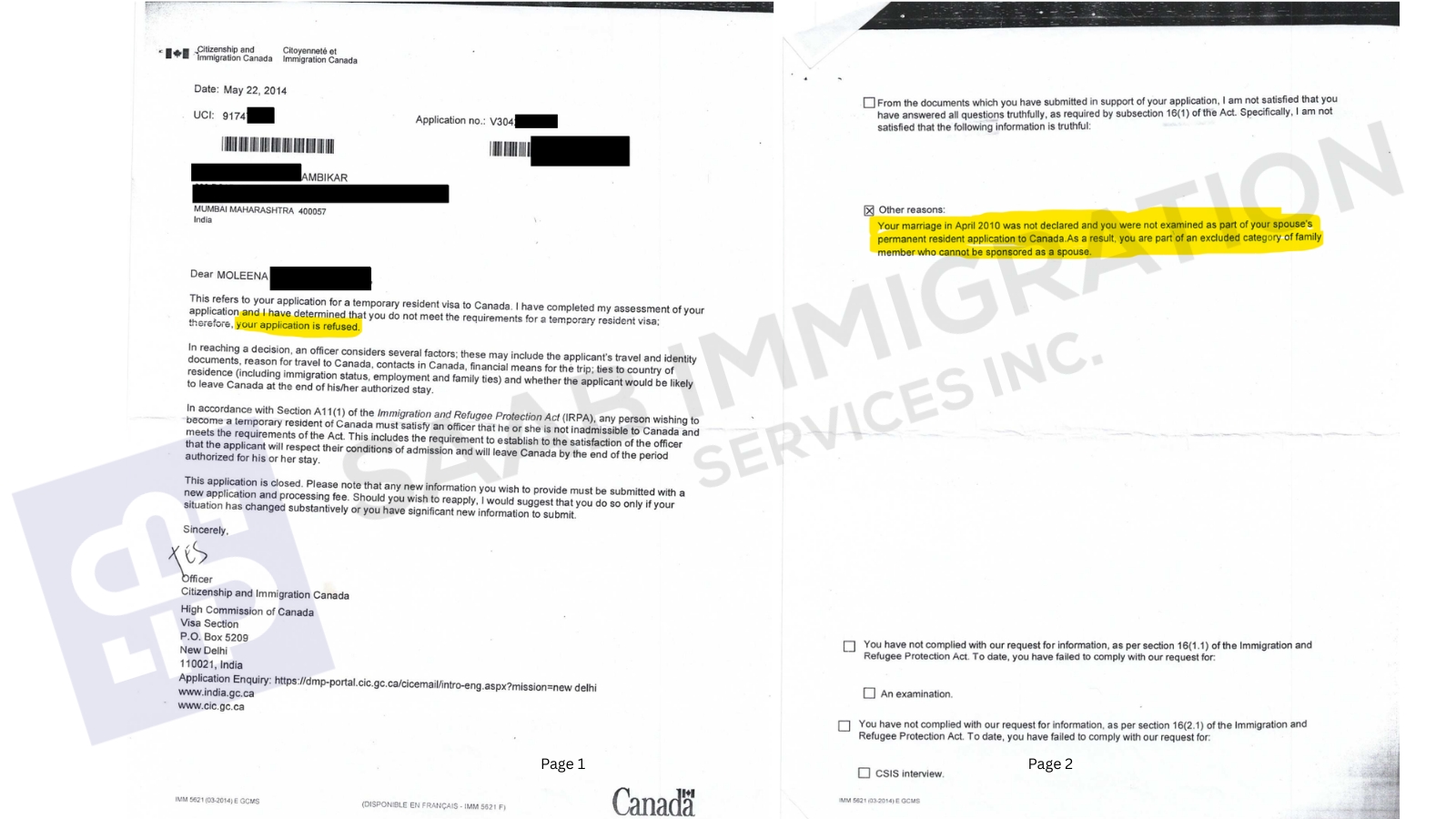
In 2014, once the family was ready to apply to bring the Applicant and their young child to Canada, the refusal letter arrived with this line:
“Your marriage in [2010] was not declared and you were not examined as part of your spouse’s PR application to Canada. As a result, you are part of an excluded category of family members who cannot be sponsored as a spouse.”
The child, a minor at the time, was refused in that same decision, for the same underlying reason. That single sentence became the wall this family lived behind for years to come.
The Refusal Letter, 2014: “Excluded Category of Family Members”
Try, for a moment, to sit with what that actually means: you’ve built a life in a country you now call home, and the person you married, the family you started, is thousands of kilometres away. You see them once or twice a year if you’re lucky. You’re married, but you’re living the reality of a long distance relationship with no clear end in sight, because every professional you’ve spoken to has told you there’s no way through. That’s not a file to me. That’s a family’s life on hold. This is exactly why I specialize in family class work.
A Visitor Visa, a Pandemic, and a Long Wait
Between 2014 and 2020, believing the sponsorship door was closed for good, the family lived with the separation. In 2020, an unlicensed individual posing as an immigration consultant got involved, and submitted a visitor visa application on behalf of the Applicant and her child. That application sat through the pandemic-era backlog, a period when IRCC was working through an unprecedented volume of applications under enormous strain, and was eventually approved in 2022. The Applicant and her child arrived in Canada that year.
That should have been the turning point. Instead, it became another chapter of the same problem. The same unlicensed operator who had arranged the visitor visa never actually submitted the family’s sponsorship application, despite telling them repeatedly that he had, and at points refused to give them access to their own file when asked. By the time the family realized nothing had actually been filed, the Applicant’s visitor status had lapsed, and she was out of status in Canada, again through no fault of her own.
How We Rebuilt the Spousal Sponsorship File: Restoration, Study Permit, Sponsorship, Work Permit
By the time this family found their way to SAAB Immigration Services in 2024, the child who wasn’t even born when his father landed in Canada was now a teenager.
The first thing we had to fix wasn’t the sponsorship, it was the Applicant’s status. We submitted a detailed status restoration request explaining the full fourteen year history, from the original 2010 non-declaration through the 2014 refusal to the unlicensed operator’s fraud, and asked IRCC to restore her status so the family could actually move forward on solid ground.
With status restored, we moved through the file in order: first, a study permit application for the dependent child, then the spousal sponsorship application itself, built around the original 2010 issue directly rather than around it, with a full account of exactly how the non-declaration happened and a request for humanitarian and compassionate consideration given everything this family had already lived through. Once the sponsorship was underway, we applied for a spousal open work permit for the Applicant, so she could work in Canada while the sponsorship processed.
The sponsorship application, filed in late 2024, was found eligible in early 2025. It moved forward, stage by stage, through the following year.
Why Was This Spousal Sponsorship File Referred to IRCC Etobicoke?
At a certain point in 2026, the file was referred to the IRCC Etobicoke office. Etobicoke handles files that fall outside routine processing: cases with flagged inadmissibility concerns, complex family class matters, or applications that need a closer, more detailed officer-level review rather than the standard processing stream. A referral there is a signal in itself. It means the file has been flagged as needing real scrutiny, and it usually means a generic response won’t move the needle.
What Is a Procedural Fairness Letter, and What Happened Twelve Years Later
A Procedural Fairness Letter, or PFL, is a formal notice IRCC sends when an officer has concerns about your application and wants a response before making a final decision. It is not a refusal, but it is a warning that a refusal is on the table.
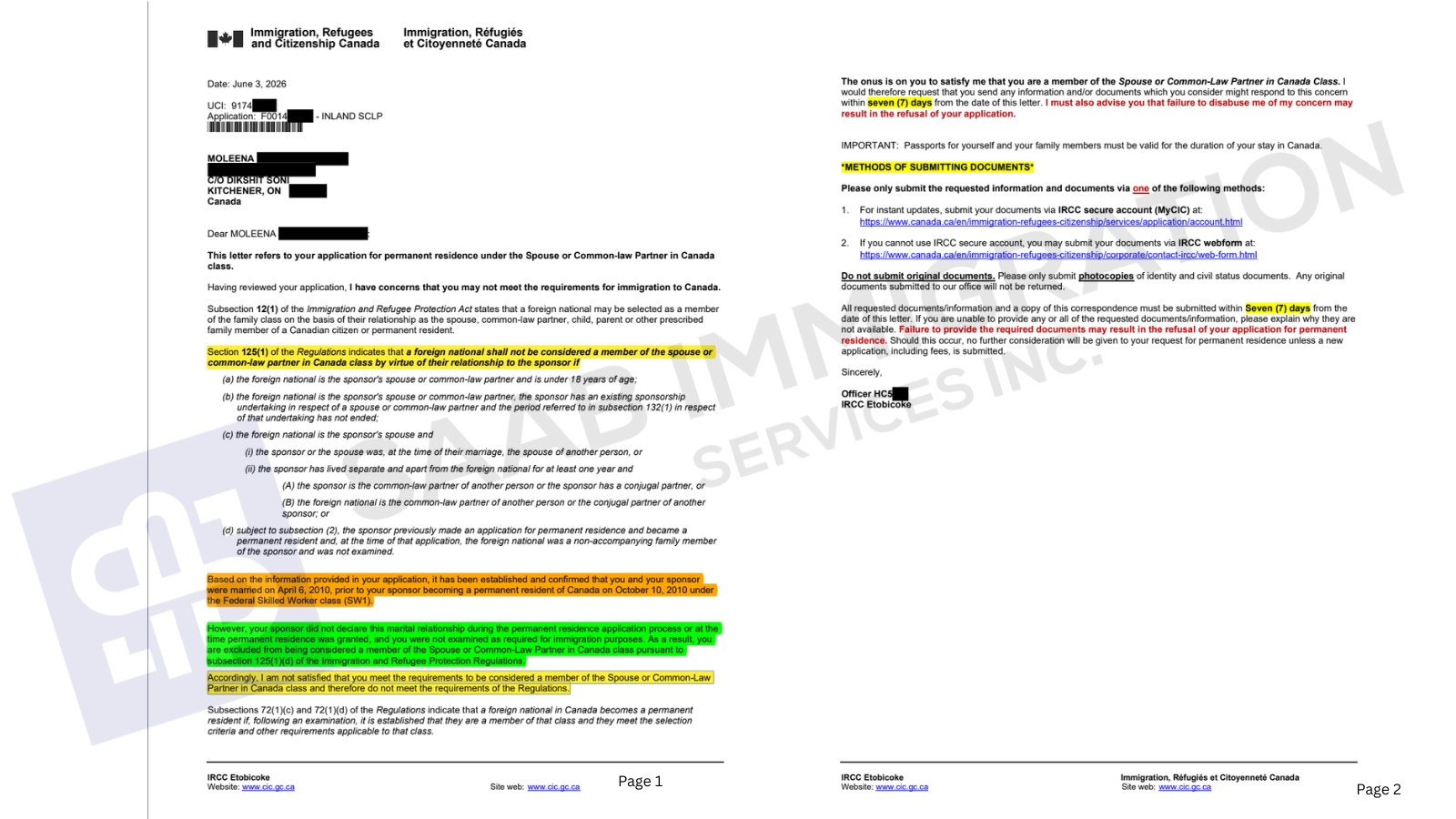
In June 2026, after the file had already cleared multiple stages of approval, IRCC issued exactly that: a PFL raising the same concern first flagged in 2014, in substance:
“Having reviewed your application, I have concerns that you may not meet the requirements for immigration to Canada.”
The letter cited section 125(1)(d) again. The same provision, the same exclusion, twelve years after the first refusal letter had already said it, and sixteen years after the 2010 marriage that started all of this. For a family that had disclosed everything, restored status properly, and waited through years of processing, watching that same clause resurface in 2026 landed like a gut punch.
Twelve Years Later, the Same Concern Resurfaces: The June 2026 Procedural Fairness Letter
How We Turned the Procedural Fairness Letter Into an Approval
We responded to the June 2026 Procedural Fairness Letter with a complete, evidence-based submission built around the family’s own history with IRCC: the disclosures already made, the approvals already granted at earlier stages, and a clear explanation of why this circumstance had already been addressed and shouldn’t be reopened without anything new on the record. We renewed the request for humanitarian and compassionate consideration, and made sure the response spoke plainly to what sixteen years of separation, 2010 to 2026, had actually cost this family.
Shortly after we filed the response, the officer assigned to the file, we’ll call her Officer C, called our office directly to discuss the case. She spoke with our RCIC, Dikshit Soni, asked a few clarifying questions, and requested an updated IMM 5669 form to bring the file current. Not long after that call, the application was approved.
The Result: Sixteen Years Later, Spousal Sponsorship Approved
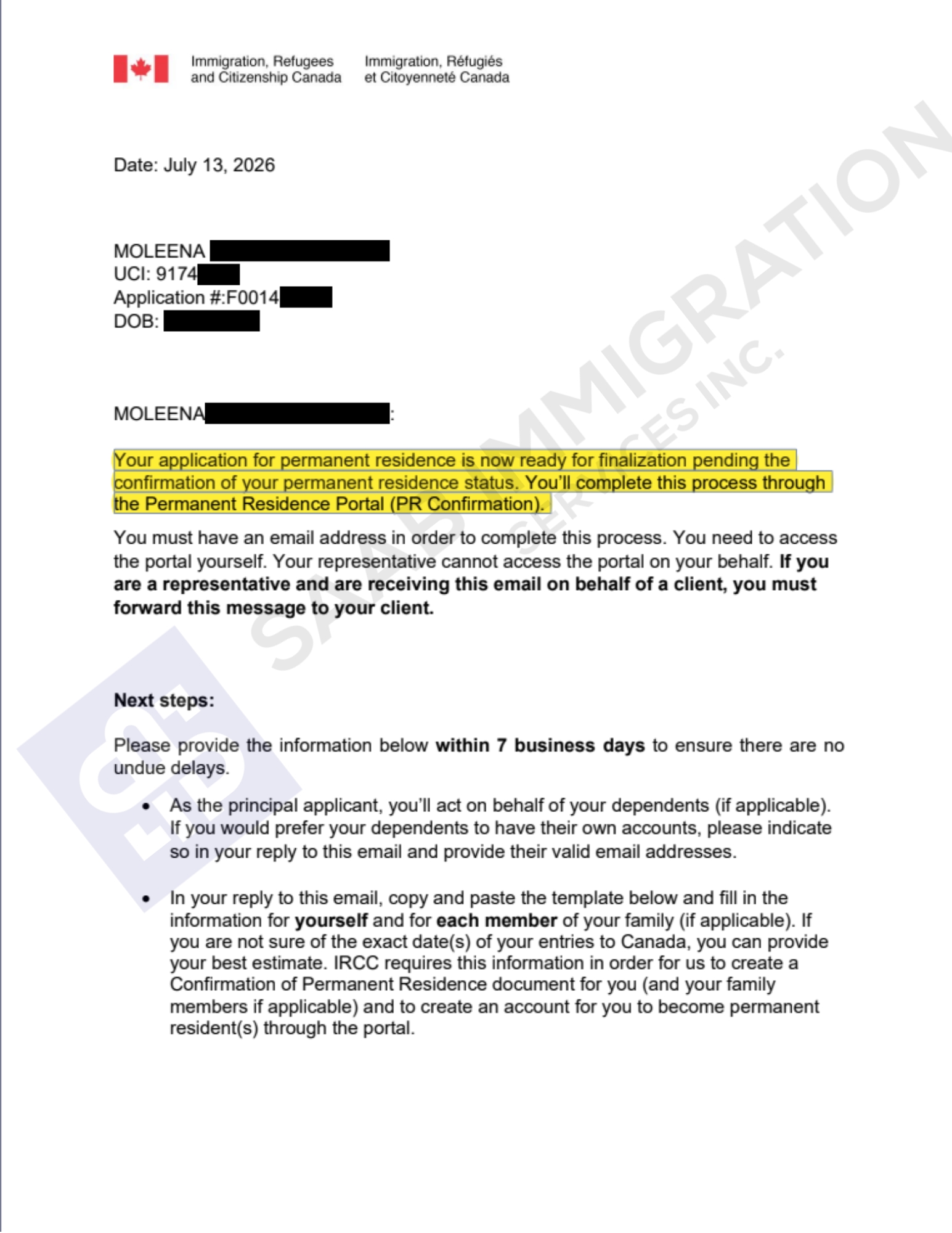
After years of being told it couldn’t be done, after a pandemic-era visitor visa that led nowhere fast, after an unlicensed operator’s fraud, after a Procedural Fairness Letter in 2026 reviving a concern first raised in 2014, this family is finally reunited in Canada as permanent residents. The Sponsor, 35 when he landed in 2010, is now 51. Their child, not even born when his father became a permanent resident, became a permanent resident himself at fifteen.
July 2026: Ready for Finalization
Sixteen years. A marriage that was never hidden, never a secret, and never should have kept this family apart for this long. Cases like this are exactly why family class work is the part of this job I care most about, and this one finally has the ending it deserved.
Book a Consultation or call +1 (877) 683‑7222 (SAAB) or email us at hello@saabimmigration.ca.
