

Key HighlightsUpdated September 9, 2026
- Paragraph 188(1)(c) lets you study without a study permit only if the course is six months or less and it finishes within the stay you were authorized on entry.
- The IRCC website summary and the wording of the Regulations are not the same thing, and the Federal Court has said an officer must apply the Regulations.
- An extension granted later does not stretch that window backwards.
- Since September 4, 2026 a temporary public policy fills that gap. If you hold a valid work permit you may study for six months or less, whatever the permit is and whenever you got it. It runs until December 31, 2027.
- The earlier policy did the same job from June 27, 2023, but only for permits applied for on or before June 7, 2023. It expired on June 27, 2026, leaving a gap until the new one started.
- Watch out. The new authorization ends when your work permit ends. It does not continue into maintained status, even if you filed your extension on time.
- Separate rule, separate cost. Any months you spend in full-time study are excluded from Canadian Experience Class work experience under 87.1(3)(a), however many hours you work. Part-time study is not.
- The answer changes with your status, so read the situation that matches you.
- Unauthorized study is not just a refusal. Section 221 bars a study permit for six months afterwards, measured from the day you file.
There is one line that continues to circulate widely across immigration forums, WhatsApp groups, and even professional advice:
“You don’t need a study permit if your course is 6 months or less.”
On its face, that statement is not incorrect. But it is incomplete, and in many cases, it is being applied in ways that may not align with the actual law.
The purpose of this article is not just to restate what is already available on IRCC’s website, but to unpack what the legislation actually says, how it applies in real-world situations, and where misinterpretation can quietly create problems later in a person’s immigration journey.
This question comes up frequently, particularly from individuals already in Canada on work permits, including PGWP holders, who are trying to understand whether they can take short-term courses without applying for a study permit.
Key point
Summary in a Nutshell:
- The rule is not simply “6 months or less = no study permit required.”
- Under IRPR Section 188(1)(c), a short-term course must also be completed within the period authorized upon entry into Canada.
- That original authorization period is the key reference point: for visitors, typically 6 months from entry; for study permit holders, the validity of the original study permit; and for work permit holders, the validity of the original work permit.
- Important exception: temporary public policy has twice lifted this entry based limit for work permit holders. The 2023 policy did it only if your work permit or extension application was submitted on or before June 7, 2023, and it expired on June 27, 2026.
- A new public policy took effect on September 4, 2026 and is far wider. Any valid work permit qualifies, whenever it was issued and however you obtained it. It runs until December 31, 2027, and your authorization ends when your work permit ends.
- Extensions, visitor records, study permit extensions, or later status changes may create situations that fall outside the Section 188 exemption.
- This is especially important for PGWP holders taking short-term programs while continuing to work and planning for CEC or other PR pathways.
- The simplified guidance on Canada.ca is a summary. The actual legal test lies in the wording of the legislation and how it applies to your specific status history.
- If this issue applies to you, do not wait until a refusal or eligibility issue surfaces later, by then, options may already be limited.
Quoting the Summary vs Interpreting the Actual Law
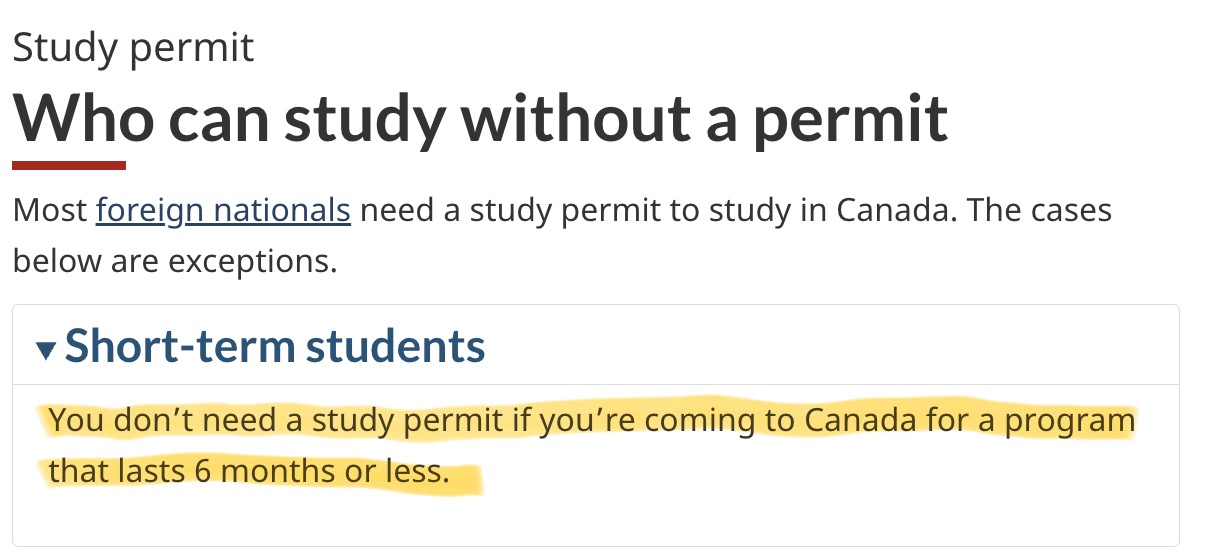
If you visit the official IRCC page, the guidance is intentionally simplified: you do not need a study permit if your program is 6 months or less. That summary is designed for general understanding. However, the governing law is not written in that simplified format.
________
Screenshot below from IRCC’s general information page on Who can Study without a permit. Link here
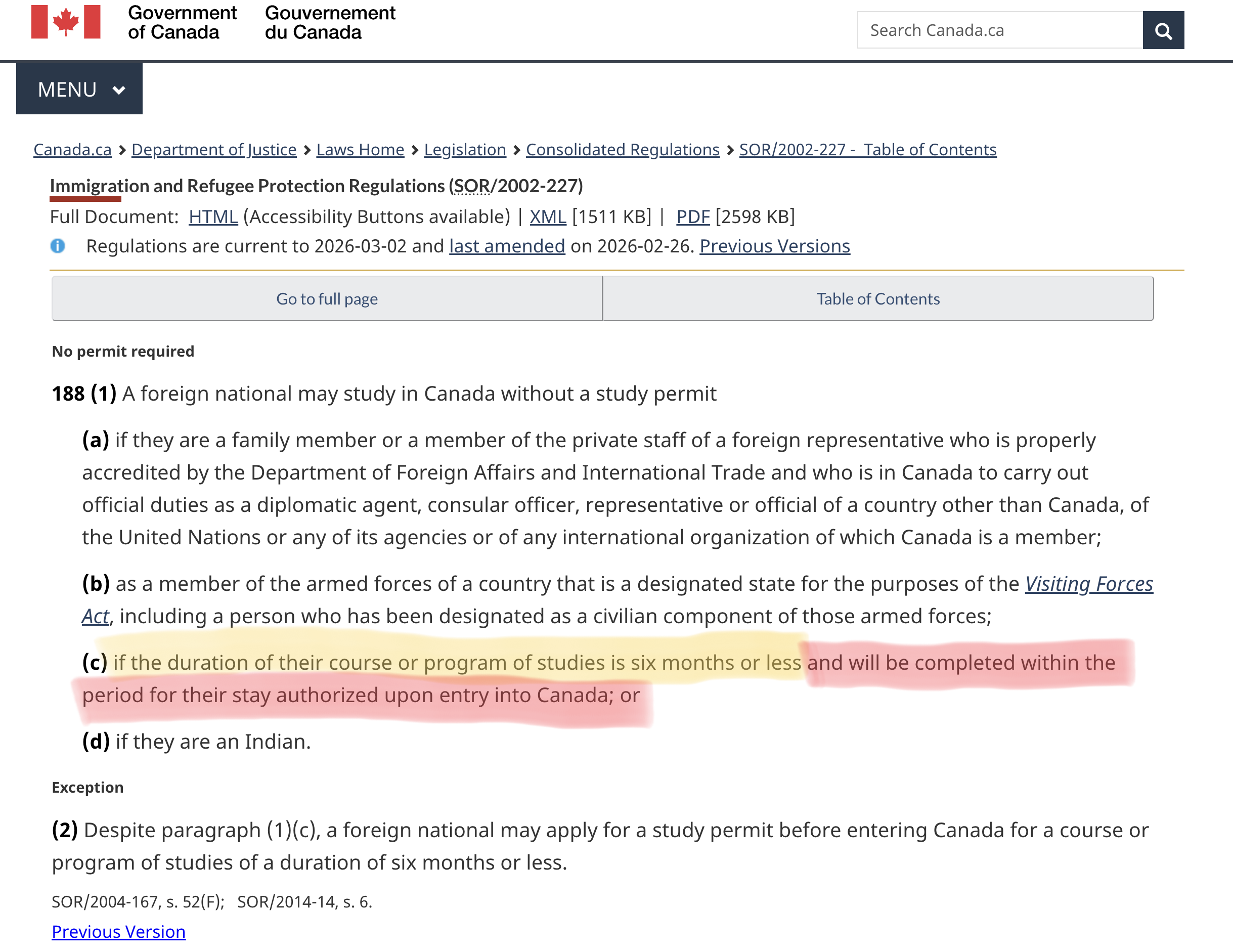
The actual provision comes from Section 188(1)(c) of the Immigration and Refugee Protection Regulations (IRPR), which states that a foreign national may study in Canada without a study permit if the duration of the course or program is six months or less and it will be completed within the period for their stay authorized upon entry into Canada.
The first half of that sentence is widely known. The second half is often overlooked, and it is where the legal test lies.
________
This is the screenshot from laws-lois.justice.gc.ca. Link here
Important Exception: Temporary Public Policy for Certain Work Permit Holders
It is important to note that there is a separate temporary public policy currently in place that allows certain work permit holders to study in Canada without a study permit.
As of June 27, 2023, Immigration, Refugees and Citizenship Canada (IRCC) introduced a temporary measure allowing eligible foreign workers to study without a study permit under specific conditions.
👉 Read the official public policy here
That 2023 policy was not a blanket exemption. It was limited in scope and applied only to individuals who met specific criteria, including:
- Holding a valid work permit applied for on or before June 7, 2023, or
- Having a work permit extension application in progress submitted on or before that date
That policy expired on June 27, 2026. A much wider one replaced it on September 4, 2026 and runs until December 31, 2027. Under the new policy the only condition is that you hold a valid work permit. We have written that policy up in full, including the limits that catch people and the ten week gap it left behind, in Studying on a work permit in Canada: what the new policy gives you, and where it stops.
This is where confusion often arises.
Some advice in the market refers broadly to the ability of work permit holders to study without a study permit, without clearly distinguishing between:
- IRPR Section 188 (a general legal exemption tied to entry conditions), and
- This temporary public policy (a time-limited, eligibility-specific measure)
Understanding which framework applies to your situation is critical. The two are not interchangeable, and relying on the wrong one may create issues later in your immigration history.
Be mindful
Important Distinction: The 2023 Temporary Public Policy Does NOT Apply to Everyone
Yes, certain work permit holders were allowed to study without a study permit under a temporary public policy introduced on June 27, 2023.
But that measure was limited to individuals who applied for their work permit or work permit extension on or before June 7, 2023, and it expired on June 27, 2026.
That has now changed. The policy that replaced it on September 4, 2026 does cover all valid work permit holders, whenever their permit was issued.
The real issue today has moved. It is people who studied between June 27, 2026 and September 4, 2026, when the old policy had ended and the new one had not started, and people who assume the new authorization survives the expiry of their work permit. It does not.
The authorization ends with the permit, even if you filed your extension on time and are working legally on maintained status. If either of those describes you, your case needs to be analyzed under IRPR Section 188 or under the normal study permit rules, not under the public policy.
The Critical Condition
The rule is not simply about the duration of the program. It is equally about when that program is completed in relation to your immigration status.
More specifically, the law requires that the program must be completed within the period of stay that was authorized at the time you entered Canada.
This is a very important distinction. It does not refer to extensions granted later, a change of status inside Canada, or how long you are currently allowed to remain. Instead, it refers back to a fixed reference point: your original authorization period upon entry into Canada.
Understanding this properly is the key to applying Section 188 correctly.
How to Interpret “Authorized Stay Upon Entry”
To apply this rule in practice, you first have to identify what your authorized stay was at the time you entered Canada. That typically looks like this:
| Status at Entry | Authorized Stay Reference Point |
|---|---|
| Visitor | Usually 6 months from date of entry |
| Study Permit | Until expiry of the original study permit issued at entry |
| Work Permit | Until expiry of the original work permit issued at entry |
The background. In Zhang v Canada (Citizenship and Immigration), 2016 FC 964, Court file IMM-4977-15, decided 29 August 2016, Ms Jin Zhang entered Canada on a visitor visa on 23 August 2014, authorized to stay until 23 February 2015. On 5 January 2015 she began a 14 week English as a Second Language course at Lambton College, a designated learning institution. The course was a prerequisite for the two year hospitality management program she wanted to take. She later obtained an extension of her visitor status to 30 August 2015, and after finishing the ESL course she applied from inside Canada for a study permit.
What happened. The officer refused. The ESL course began on 5 January 2015 and could not possibly finish by 23 February 2015, which was the date to which she had been authorized on entry, so the officer treated the course as unauthorized study. Ms Zhang argued that IRCC’s own website said a person may study without a permit if the course is six months or less and is completed “within the time you are allowed to stay in Canada”, wording that would have included her extension. Justice Bell dismissed the judicial review. The words “upon entry into Canada” are unambiguous, and an officer is required to interpret the Act and the Regulations rather than information found on a website.
The second problem. Section 221 of the Regulations says a study permit shall not be issued to someone who has studied in Canada without authorization unless six months have elapsed since that unauthorized study stopped. Ms Zhang argued that six months had passed by the time the officer decided her file. The Court held it was not unreasonable for the officer to measure from the date the application was filed, which was about one month after the ESL course ended. The refusal stood.
Why this matters to you. An extension granted later does not stretch the window backwards. The short course has to fit inside the stay you were given when you entered. And if you get this wrong, the consequence is not only a refusal: unauthorized study closes the door on a study permit for six months, counted from when the unauthorized study stopped, and an officer may measure that against the day you file rather than the day they decide.
1Situation 1: Visitors Entering Canada
However, complications can arise when that initial stay is extended. If a visitor applies for a visitor record and remains in Canada beyond the original six-month period, and then continues or begins studying during that extended time, the situation may fall outside the scope of what Section 188 permits. This is because the program is no longer being completed within the initial authorization period at entry.
This is a subtle but very important distinction, and one that is often overlooked in practice.
| Visitor Scenario | May Fall Within Section 188? |
|---|---|
| Enters as visitor, takes course under 6 months, completes within initial 6-month stay | Yes, generally |
| Enters as visitor, later extends stay by visitor record, studies after original entry period | May fall outside Section 188 |
2Situation 2: Study Permit Holders at DLIs
However, the situation becomes more nuanced once the original program is completed. If a student finishes the main program and then applies for a study permit extension or transitions into a different program, that new period of authorization is not necessarily the same as the original “authorized stay upon entry.” As a result, enrolling in a short-term program during that extended or changed period may not fall within the same exemption.
This is where a simple “6-month rule” interpretation begins to break down.
| Study Permit Scenario | May Fall Within Section 188? |
|---|---|
| Student remains within original study permit validity and completes short-term course during that period | May fall within Section 188 |
| Student completes original program, then extends or changes study period and enrolls in short-term course afterward | May fall outside Section 188 |
3Situation 3: Work Permit Holders, Including PGWP, SOWP, and Closed Work Permits
From a purely technical standpoint, if the course is completed within the original validity period of the work permit issued at entry, Section 188 may apply. But the real issue is not just the course itself, it is how that course interacts with other conditions, particularly work authorization and future immigration pathways.
This is where real-world risk begins to appear, especially for people who are trying to maintain full-time work and build eligibility under the Canadian Experience Class.
| Work Permit Scenario | Why It Needs Caution |
|---|---|
| PGWP holder taking a short-term course | The course may not automatically fit within Section 188 if it falls outside the original period authorized upon entry as a student. |
| SOWP holder enrolling in a short program | The short duration of the course alone does not end the analysis; the original work permit validity at entry remains important. |
| Closed work permit holder studying while maintaining full-time work | The interaction between study activity, work conditions, and future PR strategy may create issues that are often underestimated. |
Can You Study a Short-Term Course While on a Work Permit in Canada?
Many people assume that holding a valid work permit automatically allows them to take short-term courses in Canada without a study permit, especially if the program is under six months. However, the answer is not a simple yes or no.
Under IRPR Section 188, the key factor is not just the duration of the course, but whether it is completed within the original period authorized at the time you entered Canada.
For many work permit holders, especially those on PGWP, this is where the situation becomes more nuanced.
If the course falls outside the scope of that original authorized period, the exemption may not apply, even if the course itself is less than six months in length.
This is why relying solely on the “under 6 months” rule can be misleading. The correct analysis depends on your entry history, current status, and how the study activity interacts with your work authorization and long-term immigration plans.
Warning
Important Warning for PGWP Holders Taking Short-Term Courses
This is where a significant amount of incorrect or incomplete advice is currently circulating in the market.
Many individuals on Post-Graduation Work Permits are enrolling in short-term programs, often in sectors such as healthcare, based on representations that no study permit is required if the program is under six months, that they can continue working full-time while studying, and that they can continue building Canadian Experience Class eligibility at the same time.
In many cases, these representations rely on the simplified IRCC website summary, not the full wording of IRPR Section 188.
The law, however, is more specific. The exemption only applies if the course is completed within the period authorized upon your original entry into Canada.
If you have already completed your initial study program, moved beyond the validity of your original study permit, and are now on a PGWP, then enrolling in a short-term course may fall outside the scope of Section 188, even if the program itself is less than six months.
That is where the real risk begins to develop.
Even if you are not trying to claim points for that short-term education itself, the underlying issue remains the same: if the program falls outside the scope of Section 188, then the fact that it is “under six months” may not save it.
And this is where many people are being given an incomplete picture. Some are being told they can study, continue to work, and keep building CEC eligibility at the same time, as if none of these issues interact. In reality, they may interact quite significantly.
If a study permit is actually required for compliance, and one is not obtained, that may create obvious problems. If a study permit is obtained, that may create a different set of practical implications, particularly in relation to work authorization and whether work experience accumulated during that period may count toward CEC.
This does not mean every case will lead to refusal. But it does mean many people are structuring their profiles based on an incomplete understanding of the law, often while paying substantial tuition fees to institutions that market these programs as fully compliant.
The position is more nuanced. And in some situations, what appears compliant on the surface may later be examined more closely during permanent residence applications, eligibility assessments, or file reviews.
If you are currently in this situation, or have already taken such a program, it is important to assess your position early. These issues do not always surface immediately, but when they do, timelines can be tight and options limited.
This section is intended for informational purposes only. If this applies to you, or if you are planning to enroll in a short-term program while on a PGWP, consider seeking proper guidance before proceeding.
If your application has already been refused, or if you have received concerns related to studying during your PGWP without a study permit, including issues raised under R188, do not ignore it. These situations can quickly become more complicated if left unaddressed. Early review of the refusal reasons, your status history, and how the studies were undertaken may make a significant difference in how the matter is approached.
If this has already happened to you, schedule a consultation with our office immediately so your case can be assessed properly before further steps are taken.
Can You Hold a Study Permit and Work Permit at the Same Time?
Yes, it is possible for a foreign national to hold both a study permit and a work permit concurrently. But that does not mean both sets of privileges can necessarily be exercised without limitation.
In many cases, study permit conditions may influence how and when a person is authorized to work. This becomes especially important for individuals attempting to continue full-time work while also pursuing studies, and even more so for those trying to preserve or build Canadian Experience Class eligibility.
The practical implication is simple: just because it is possible to hold both documents does not automatically mean a person can continue relying on the same work assumptions as before.
Why This Matters More Than Ever Right Now
This issue is not theoretical. It is increasingly relevant because many people are pursuing short-term programs in an attempt to reposition themselves for category-based draws or sector-specific opportunities, especially in healthcare and support occupations.
While the intention is understandable, the execution is not always aligned with how the law is structured. And that is where risk begins to build, often quietly, and often not at the moment of enrollment, but later during a PR application or eligibility review.
That is also why this is not a subject to leave until the last minute. If there is a problem in how your study and work history fits together, it is far better to identify it early than to discover it when your options are limited.
The second rule running alongside this one
Everything above is about whether your study is authorized. There is a separate rule about what that study does to the work you are doing at the same time, and it catches people who were perfectly authorized throughout.
It applies the same way whether you are studying on a study permit, under section 188, or under the current public policy for work permit holders. The question is not which door let you into the classroom. It is whether the program is classified as full-time.
The exclusion is triggered by the study, not by the hours you work. Working through it does not protect the experience.
Moral of the Story: Read the Rule Based on Your Own Status History
The correct way to approach Section 188 is not to ask only: “Is my course under 6 months?”
The better question is: “Is my course completed within the period authorized when I originally entered Canada?”
That date, whether tied to a visitor entry, study permit, or work permit, is the real anchor point for your analysis.
The simplified guidance on Canada.ca is useful as a starting point. But if your case involves status extensions, work permits after study, short-term private programs, or long-term PR planning, then the legislation needs to be read in context, not in isolation.
Important Disclaimer
This article is based on a technical interpretation of IRPR Section 188 and related immigration principles. Individual situations vary significantly depending on status history, permit conditions, timing, and intended immigration pathways.
This article is for informational purposes only and should not be treated as case-specific legal advice.
Before You Act, Get Clarity
Section 188 is not a loophole. It is a narrow exemption with specific conditions.
And while it can be applied correctly in many cases, it can also be misapplied very easily when taken out of context. The consequences, if they arise, are not always immediate, but they may surface later during application reviews, eligibility assessments, or compliance checks.
That is why this is one of those areas where incomplete advice can get messy very quickly.
If you are currently on a PGWP or work permit, considering enrolling in a short-term program, or planning your PR pathway through CEC or category-based draws, this is not an area where assumptions are advisable.
A small misunderstanding today may create complications later, particularly when timelines become tight and options become limited. If you want a proper assessment based on your current status, entry history, and long-term immigration goals, reach out to our office.
Frequently Asked Questions
- Can I study in Canada without a study permit if my course is under 6 months? Possibly, but not automatically. Under IRPR Section 188, the course must not only be six months or less, it must also be completed within the period authorized upon your original entry into Canada. That second part is where many people get caught.
- Can I take a short-term course while on a PGWP without a study permit? Maybe, but only if it still falls within the period authorized upon your original entry into Canada. If you already completed your initial study period and are now on a PGWP, a short-term course may fall outside the scope of Section 188 even if it is less than six months long.
- Does a visitor record extension let me continue studying under Section 188? Not necessarily. A visitor record may extend your legal stay in Canada, but Section 188 refers to the period authorized upon entry, not an extension granted later. That distinction is critical.
- Can I hold both a study permit and a work permit at the same time? Yes, that may be possible in some cases. However, that does not mean both sets of privileges can always be exercised freely at the same time. Study conditions may affect how and when you are allowed to work, and that can become important for future immigration applications.
- Will work experience gained while doing a short-term course count toward CEC? Not always. If your study situation affects your work authorization or places you in a category where the work is no longer counted the same way, that experience may not help with Canadian Experience Class (CEC) eligibility in the way people expect.
- Why are so many people getting this wrong? Because most advice in the market stops at the simplified IRCC summary that says “6 months or less” and never goes on to explain the actual wording of the law. The legislation is more specific, and the missing part is often what creates problems later.
- What should I do before enrolling in a short-term program? Look at your original status upon entry to Canada, identify the end date of that original authorization, and assess how the new course may affect your work conditions and long-term immigration plans. If there is any doubt, get proper advice before enrolling.
If You Have Already Been Refused Under R188 or Related Study Permit Issues
If your application has already been refused because you studied in Canada without the proper authorization, or if concerns were raised about how IRPR Section 188 applied to your situation, do not assume the matter is minor or will fix itself later.
These cases may affect future study permit, work permit, or permanent residence applications depending on how the issue is framed in your immigration history.
If you are dealing with a refusal connected to short-term studies, PGWP, or study activity that may have fallen outside the scope of R188, it is best to reach out to us early.
👉 Read more about refusal cases and your options here
Want to Discuss Your Situation?
If you are currently in this situation, or even suspect that something in your study, work, or status history may not align cleanly, this is not something to leave for later.
At our office, we routinely work with cases where options are already limited, timelines are tight, or previous decisions were made based on incomplete or incorrect advice.
That is exactly where our experience comes in.
Every case we handle is assessed individually, not through templates, not through assumptions, but based on your actual status history, documentation, and long-term immigration goals.
If this applies to you, or to someone you know, it is always better to address it early rather than try to fix it when options become restricted.
Speak with Dikshit Soni, RCIC and our team at SAAB Immigration Services for a clear, grounded assessment of your situation.
📅 Book a Consultation
📩 hello@saabimmigration.ca
📞 +1 (877) 683-7222 (SAAB)
Most study permit refusals are written before the file is filed
Key pointRelated reading
For a worked example of how a permit refusal ends status the same day, see CBSA at the Calgary Student Protest: What Happened, and What the Law Actually Says.
