

- Canada has confirmed a one time pathway of 33,000 permanent residence spots for temporary residents already here, with more details expected in April 2026.
- As of 17 March 2026, Express Entry had issued 49,224 invitations in 2026, the highest first quarter on record and roughly 43 per cent of the full year 2025 total of 113,998.
- Of those, 31,224 invitations came through pathways that require or strongly favour candidates already in Canada, against 12,183 in Q1 2025 and 11,059 in Q1 2023.
- CEC draw sizes rose from 1,000 per draw to between 4,000 and 8,000 from December 2025, but the CRS decline has slowed, moving only from 511 to 507 since January 2026.
- Rather than paying for early access, prepare the documents needed anyway, language results, ECAs, police certificates, medicals and work reference letters, and keep your status secure.
What is the TR to PR pathway in Canada 2026?
Canada has confirmed a one-time pathway offering 33,000 permanent residence spots for temporary residents already in the country. However, eligibility criteria, intake structure, and application details have not yet been officially released.
Canada’s Immigration Minister confirmed in March 2026 that a one-time pathway to permanent residence for 33,000 temporary residents is already in effect.
That announcement is important. But as of the time of writing, the pathway still lacks the kind of detail applicants actually need: there are no clear eligibility criteria, no formal application process has been announced, and no official intake structure has been released.
Even so, the selling has already begun. Across the market, we are seeing early retainers, “priority access” language, and checklists being promoted for a pathway that has not yet been fully operationalized in public.
That disconnect is exactly what this article aims to clarify.
To be fair, one important public signal has been made. Immigration Minister Lena Metlege Diab said in an interview that the program had been launched quietly, with more details to come in April, as reported by the Toronto Star on March 6, 2026. That is significant. It confirms the pathway is not imaginary. But it still does not answer the real operational questions applicants need answered.
We deliberately held off on writing about this earlier. Without enough data, any conclusion would have been premature. But now, once the early 2026 draw pattern is examined properly, the better question is no longer whether a TR-to-PR transition is coming.
The better question is this: is part of that transition already being executed through Express Entry itself?
Summary in a Nutshell:
- Canada has confirmed a 33,000-spot TR-to-PR style pathway, but key operational details are still missing.
- As of March 17, 2026, Express Entry has already issued 49,224 ITAs in 2026 so far, and more rounds of invitations may follow before Q1 is out.
- Out of those, 31,224 invitations appear to be tied to pathways that largely require or strongly favour candidates already inside Canada.
- That same Q1 in-Canada focused total was only 12,183 in 2025, 1,125 in 2024, and 11,059 in 2023.
- CEC draws jumped from 1,000 ITAs to 6,000 to 8,000 ITAs beginning in December 2025, but the CRS decline has now slowed sharply.
- This does not look like broad long-term expansion. It looks more like front-loaded intake and reallocation of people already in Canada into permanent residence.
- Candidates should focus less on speculation and more on readiness: language results, ECAs, PCCs, medicals, work reference letters, and above all, keeping legal status secure.
What We Know vs What Is Being Sold
What we know officially:
- A one-time pathway for 33,000 temporary residents has been referenced
- The focus appears to be on people already in Canada
- It is likely tied to labour needs, including in-demand sectors and possibly rural priorities
- More details were expected in April 2026
What we do not know:
- Exact eligibility criteria
- Whether CRS will apply
- Whether this will be Express Entry-linked, separate, or some hybrid model
- How the 33,000 spaces will be distributed
- Whether intake will be capped by occupation, sector, location, or current status
That gap between what is known and what is already being marketed is precisely where people get exploited.
Let’s also be honest about these so-called “special checklists” already being sold in the market. Most of what is being packaged right now is not pathway-specific magic. It is the same standard readiness material serious applicants should already have ready:
- Police certificates
- Medicals
- Work reference letters
- Education documents
- ECA for foreign credentials
- Status documents
- Identity and civil documents
- Language test results
These are not unique to the TR-to-PR pathway people are waiting for. These are core documents for Express Entry, PNPs, and other economic immigration programs too.
So prudence is not paying someone for “early access.” Prudence is making sure your file is professionally ready regardless of which intake opens first.
So Where Is This Showing Up Already?
The real story is in the data; and not in the marketing.
And this is where the story gets more interesting.
Express Entry Invitations by Quarter (2022 to 2026): Why Q1 2026 Looks Exceptionally Front-Loaded
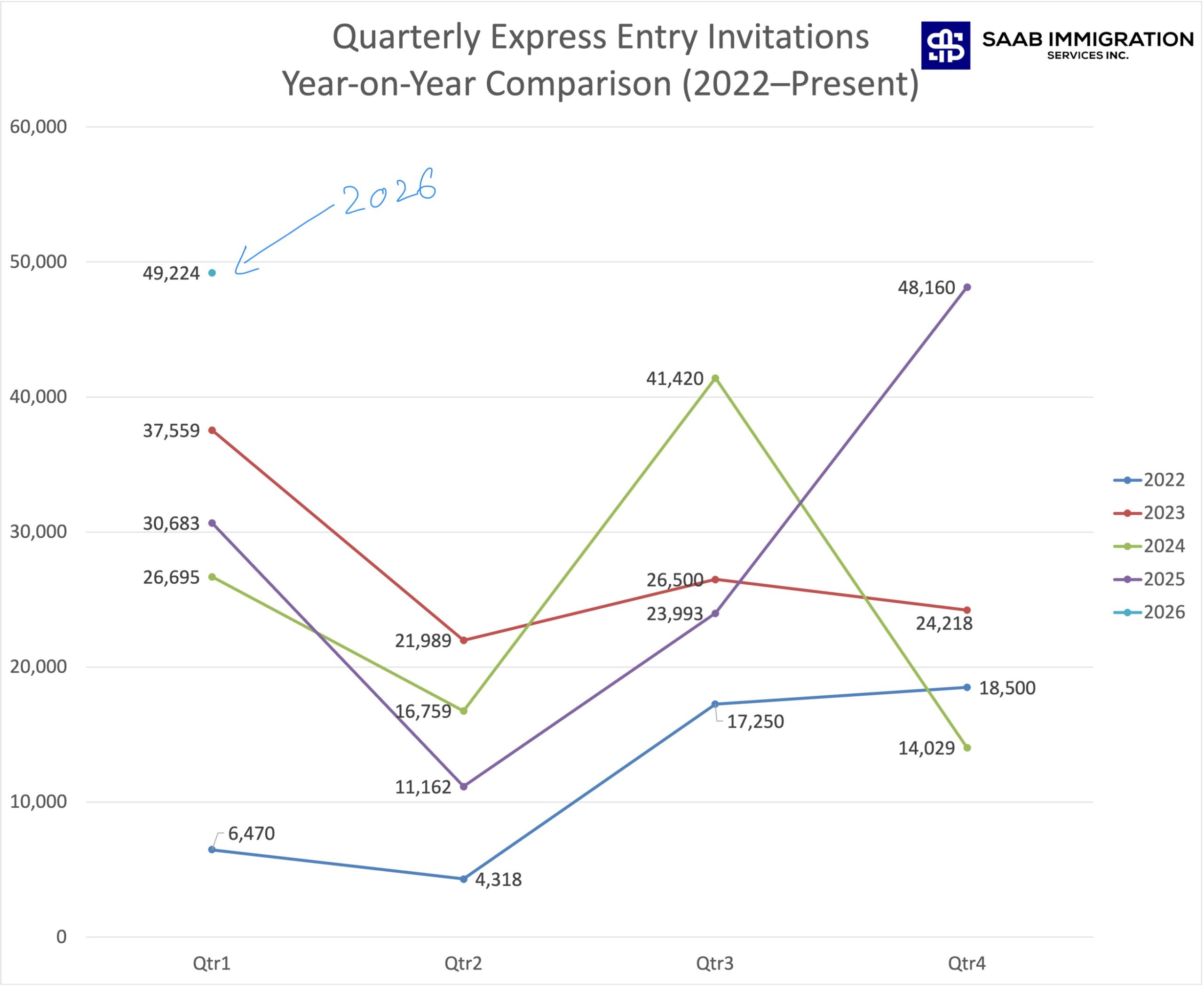
The first sign is simply the scale of invitations being issued in early 2026.
Express Entry Invitations by Quarter (2022 to 2026)
| Quarter | 2022 | 2023 | 2024 | 2025 | 2026 | Grand Total |
|---|---|---|---|---|---|---|
| Qtr1 | 6,470 | 37,559 | 26,695 | 30,683 | 49,224 | 150,631 |
| Qtr2 | 4,318 | 21,989 | 16,759 | 11,162 | , | 54,228 |
| Qtr3 | 17,250 | 26,500 | 41,420 | 23,993 | , | 109,163 |
| Qtr4 | 18,500 | 24,218 | 14,029 | 48,160 | , | 104,907 |
| Grand Total | 46,538 | 110,266 | 98,903 | 113,998 | 49,224 | 418,929 |
As of March 17, 2026, Express Entry has already issued 49,224 invitations. And with additional draws still possible before the end of March, that number may increase further before Q1 even closes.
That is the highest Q1 on record in the data you provided.
It also means that by mid-March 2026, invitations are already at roughly 43% of the full-year 2025 total of 113,998.
That is a crucial number.
It tells us two things:
- IRCC is issuing invitations far more aggressively at the start of the year than normal.
- There is very little reason to assume that pace continues unchanged for the remaining 9.5 months of the year.
This does not look like routine annual rhythm. It looks front-loaded.
The More Important Question: Who Is Actually Being Invited?
Broad draw numbers are useful, but they do not tell the full story.
The stronger signal appears once we isolate pathways that effectively require, or strongly favour, people already in Canada, in other words, people who are already temporary residents here.
For this purpose, I am focusing on:
- Canadian Experience Class (CEC)
- PNP pathways heavily favouring in-Canada candidates in this period
- Other targeted categories tied to Canadian experience / in-Canada positioning
French draws are excluded intentionally here because they are not limited to candidates already inside Canada.
Q1 Invitations Through In-Canada Express Entry Pathways (2023 to 2026)

Q1 Express Entry Invitations Through Pathways Requiring or Strongly Favouring Canadian Experience
| Year | CEC | Other Targeted | PNP | Grand Total |
|---|---|---|---|---|
| 2023 (Q1) | , | 3,300 | 7,759 | 11,059 |
| 2024 (Q1) | , | 1,125 | , | 1,125 |
| 2025 (Q1) | 9,350 | , | 2,833 | 12,183 |
| 2026 (Q1, as of Mar 17) | 28,000 | 641 | 2,583 | 31,224 |
| Grand Total | 37,350 | 5,066 | 13,175 | 55,591 |
This is where the pattern becomes difficult to dismiss.
By March 17, 2026, Express Entry has already issued 31,224 invitations through pathways that overwhelmingly favour temporary residents already inside Canada.
Compare that to the same Q1 period:
- 11,059 in 2023
- 1,125 in 2024
- 12,183 in 2025
- 31,224 in 2026
That is not just a rise but a structural shift.
If the federal government has quietly launched a TR-to-PR style transition and more details are still to come, then one reasonable reading of the data is this:
Part of that transition may already be happening through Express Entry draw behaviour, particularly through in-Canada categories.
That does not mean a separate pathway may not still emerge in a more visible form. It means the government may already be absorbing temporary residents into PR at scale while the market is still waiting for a polished public rollout.
If This Feels Like a Surge, It Is… But That Does Not Mean It Will Last
This is where people need to calm down and think like planners, not just like hopeful applicants.
Historically, Q1 can be strong, but this kind of front-loading has consequences.
Because annual immigration levels are fixed, an aggressive start means one of two things later:
- Invitation volumes normalize or taper,
- or other streams get compressed later in the year.
The 2026 immigration levels plan matters here. Canada cannot invite at this Q1 pace indefinitely unless there is room in the year-end targets to support it. That is why looking only at a few exciting draws without looking at the annual intake ceiling is misleading.
CEC Draws Since August 2025: Higher ITAs, Slower CRS Drops, and Early Signs of Plateau
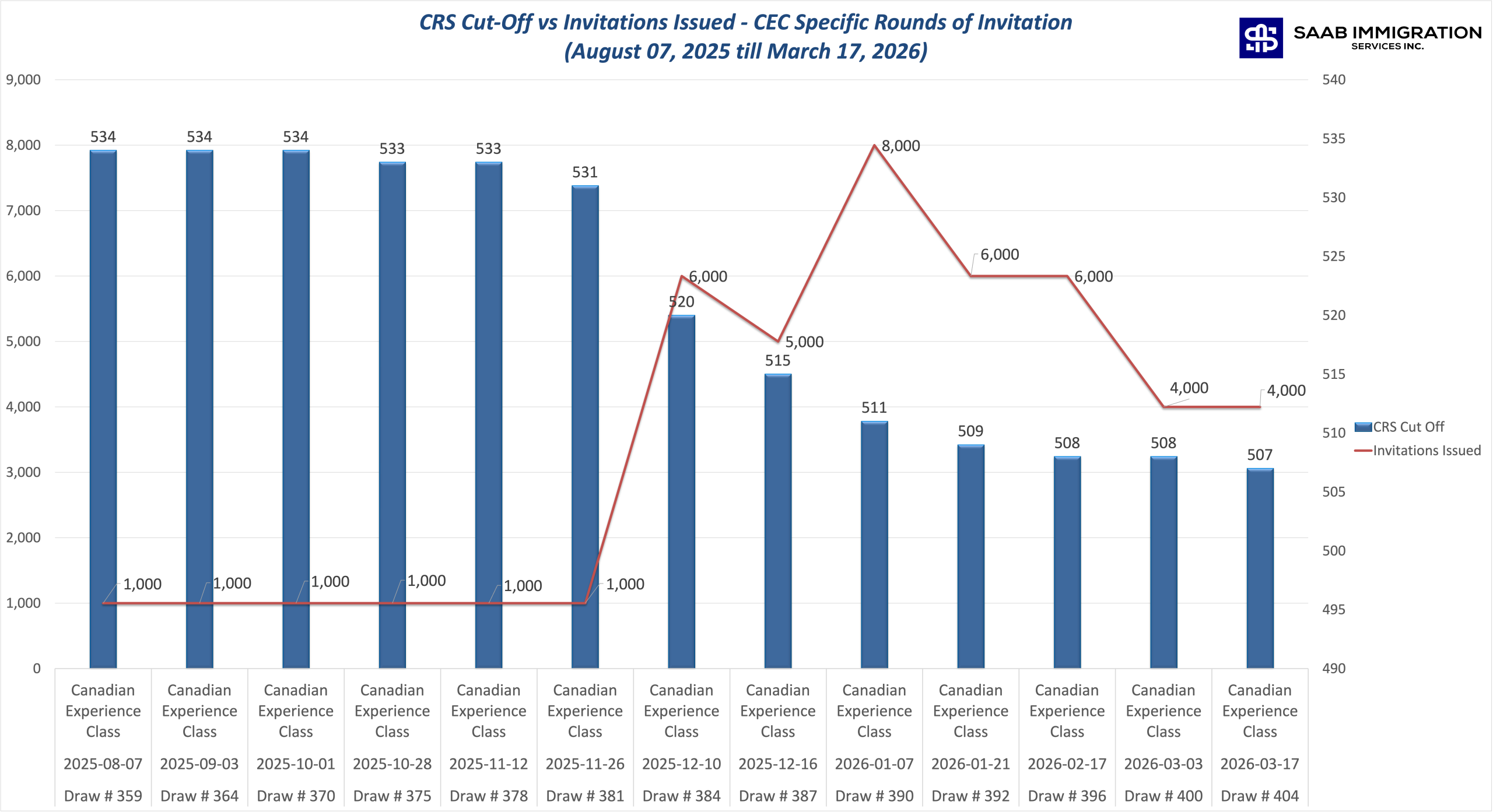
This graph tells the second half of the story.
The Q1 surge did not happen out of nowhere. It was preceded by a dramatic shift in how CEC draws were being run starting in December 2025.
CEC-Specific Draws: CRS Cut-Off vs Invitations Issued (Aug 2025, Mar 17, 2026)
| Draw Date | Draw # | CRS Cut-Off | Invitations Issued |
|---|---|---|---|
| 2025-08-07 | Draw #359 | 534 | 1,000 |
| 2025-09-03 | Draw #364 | 534 | 1,000 |
| 2025-10-01 | Draw #370 | 534 | 1,000 |
| 2025-10-28 | Draw #375 | 533 | 1,000 |
| 2025-11-12 | Draw #378 | 533 | 1,000 |
| 2025-11-26 | Draw #381 | 531 | 1,000 |
| 2025-12-10 | Draw #384 | 520 | 6,000 |
| 2025-12-16 | Draw #387 | 515 | 5,000 |
| 2026-01-07 | Draw #390 | 511 | 8,000 |
| 2026-01-21 | Draw #392 | 509 | 6,000 |
| 2026-02-17 | Draw #396 | 508 | 6,000 |
| 2026-03-03 | Draw #400 | 508 | 4,000 |
| 2026-03-17 | Draw #404 | 507 | 4,000 |
This trend matters because it shows two phases very clearly.
Phase 1: The release
From August through late November 2025, CEC invitations were effectively stuck at 1,000 per draw. Scores stayed frozen in the 531 to 534 range.
Then, in December 2025, invitation volumes jumped massively:
- from 1,000
- to 6,000
- then 5,000
- then 8,000
- then stabilizing between 4,000 and 6,000
That is not a minor adjustment. That is a policy shift.
Phase 2: The slowdown in CRS decline
At first, bigger draws produced clear score drops:
- 531 → 520
- 520 → 515
- 515 → 511
But after that, the effect weakened:
- 511 → 509
- 509 → 508
- 508 → 508
- 508 → 507
This is exactly what you would expect once the easiest score correction has already happened.
We are now seeing plateau behaviour.
That matters because it signals the system is entering what can fairly be called a regression phase:
- more ITAs are still helping,
- but they are no longer driving major CRS relief,
- and once invitation sizes start tapering later in the year, scores could easily stabilize or rise again.
So yes, the current pattern helped many people. But no, that does not mean candidates should assume the generous phase lasts indefinitely.
Long-Term Context: This May Not Be Expansion, but Reallocation.
To understand why, we need to zoom out.
Express Entry by Year: Draw Volume, CRS Averages, and Invitations Issued
| Year | Average CRS | Invitations Issued | # of Draws | Max CRS | Min CRS | Avg Invitations / Draw |
|---|---|---|---|---|---|---|
| 2015 | 538 | 31,063 | 23 | 886 | 450 | 1,351 |
| 2016 | 491 | 33,782 | 27 | 786 | 453 | 1,251 |
| 2017 | 443 | 86,023 | 30 | 775 | 199 | 2,867 |
| 2018 | 449 | 89,800 | 28 | 902 | 284 | 3,207 |
| 2019 | 451 | 85,300 | 26 | 475 | 332 | 3,281 |
| 2020 | 530 | 107,350 | 37 | 808 | 415 | 2,901 |
| 2021 | 595 | 114,431 | 42 | 813 | 75 | 2,725 |
| 2022 | 646 | 46,538 | 24 | 808 | 491 | 1,939 |
| 2023 | 505 | 110,266 | 42 | 791 | 354 | 2,625 |
| 2024 | 544 | 98,903 | 52 | 816 | 336 | 1,902 |
| 2025 | 597 | 113,998 | 58 | 855 | 379 | 1,965 |
| 2026 (as of Mar 17) | 553 | 49,224 | 16 | 789 | 169 | 3,077 |
| Grand Total | 534 | 966,678 | 405 | 902 | 75 | 2,387 |
The figure that jumps out here is not just the total invitations. It is the average invitations per draw in 2026: 3,077.
That is the highest average in the table.
Again, before the end of March.
This does not look like long-term expansion. It looks like the system is being used to absorb a defined group more aggressively up front.
That is why “TR to PR is coming” may already be the wrong tense.
A better way to say it may be:
TR to PR is already being partially executed through the selection pattern.
Immigration Levels Still Matter
2026 Immigration Levels Plan: Why the Current Pace Is Not Random, But Still May Not Last All Year
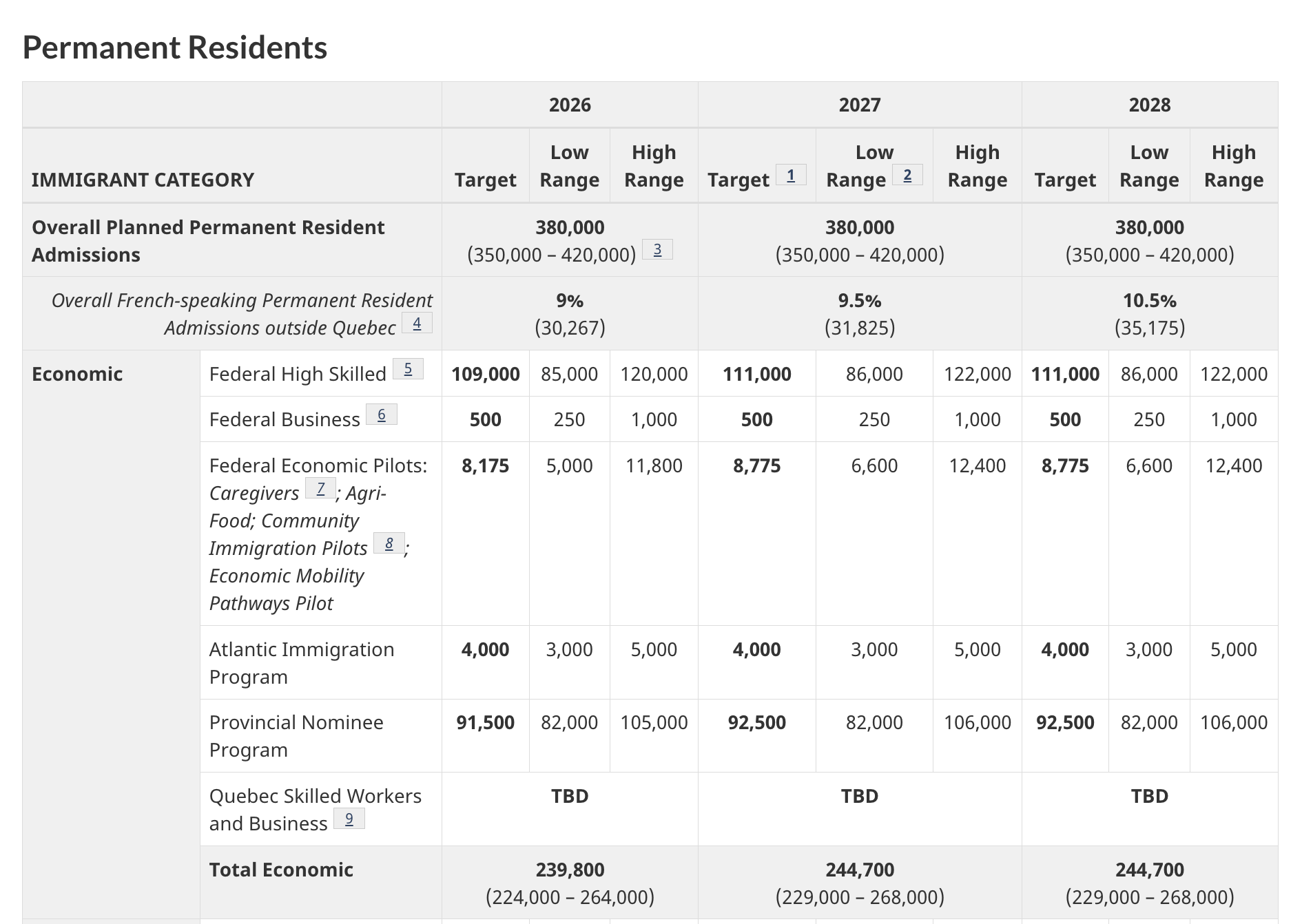
One important nuance: the 2026 plan is structured differently from the 2025 plan. The categories are grouped more broadly on paper, which makes actual draw behaviour even more important to watch.
This is where the immigration levels plan becomes important. Because once you look at the 2026 framework, it becomes much easier to understand why early 2026 draw behaviour looks the way it does.
The federal government has not just spoken generally about helping people already inside Canada. It has clearly kept economic immigration focused on categories that can be selected and managed more strategically.
In the 2026 Levels Plan, the structure is presented a little differently than some earlier breakdowns. Instead of separately labeling streams like “In-Canada Focus” or “Federal Economic Priorities,” the plan now groups a large part of economic selection under broader headings, most notably Federal High Skilled: 109,000.
That distinction matters.
It does not mean the in-Canada emphasis has disappeared. It means the policy structure is being shown more broadly, while the operational behaviour still has to be read through the actual invitation patterns.
And that is exactly why the draw data in this article matters so much. The labels may look broader, but the invitation behaviour still shows a strong tilt toward candidates who are already inside Canada.
And if we compare that with the prior year, the continuity becomes even clearer. (The categories are not labeled identically across the two plans, so this is not a strict apples-to-apples comparison. But the policy direction is still visible when you read the targets together with the draw behaviour.)
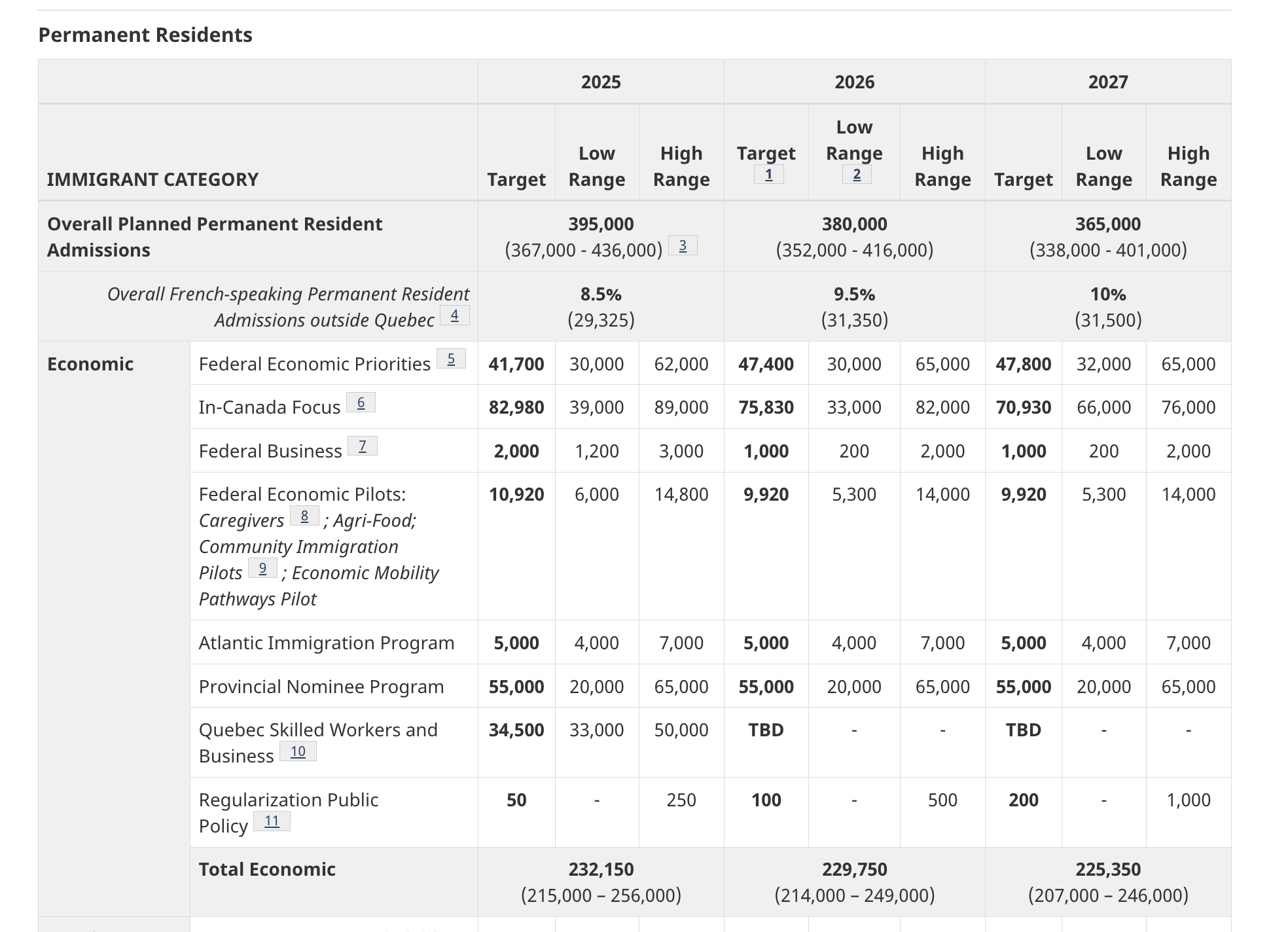
- 2025 In-Canada Focus target: 82,980
- 2025 Federal Economic Priorities target: 41,700
So this is not a sudden 2026 shift. The in-Canada emphasis was already embedded in the system in 2025, and in 2026 the structure may be broader on paper, but the execution still appears to be strongly aligned toward candidates already here.
In other words, the labels may have changed, but the behaviour has not changed nearly as much.
At the same time, one important distinction must be kept in mind: admissions targets are not the same as invitations issued.
An ITA does not equal PR. There are processing timelines, refusals, withdrawals, and other variables in between. So this is not a direct one-to-one pipeline.
However, taken together with the Q1 data, the message is clear:
The current draw behaviour is aligned with policy direction, particularly toward candidates already inside Canada.
For CEC candidates, this is a positive signal.
But it still does not mean that waiting for a standalone, clearly packaged TR-to-PR program is the best strategy.
If anything, the evidence suggests that part of that transition is already happening through the system as it exists today.
That is why the current surge should be understood as front-loaded intake aligned with policy, not as a permanently expanded invitation environment.
What This Means for Candidates Right Now
This is where many people are getting it wrong.
They are reacting to speculation by spending money on “early access,” “priority processing,” or pathway-specific preparation for something that has not even been formally defined.
That does not mean do nothing. It means do the right things.
Prepare the documents that matter anyway
Get your core file in order:
- Language test results
- Education documents
- ECA for foreign education
- Work reference letters
- Police certificates
- Medicals where appropriate
- Status records
- Identity and civil documents
These documents are not specific to one pathway. They are required across Express Entry, PNPs, and most economic immigration programs.
So preparing them is not speculation. It is basic readiness.
Keep your status under control
This is critical.
Do not let your temporary status fall apart while waiting for something that may or may not come in a specific form.
If your permit is expiring, if you need restoration, or if your situation is unclear, address that first.
Opportunities only matter if you remain eligible to use them.
Free PR Readiness Checklist
To anyone reading this, do not fall for hype, vague promises, or paid urgency around programs that are not clearly defined yet.
In practice, much of what is marketed as “exclusive preparation” is simply standard documentation that serious applicants should already have ready.
So instead of adding to that noise, here is something more useful.
Below is a structured checklist based on the same preparation framework we use with our clients, covering the core documents typically required across Express Entry, PNPs, and other economic permanent residence pathways.
You are free to use it, save it, and share it.
👉 Download the Express Entry Checklist
This checklist is not tied to one specific program. It is not a shortcut. And it does not guarantee eligibility.
What it does do is ensure that when real opportunities open, whether through Express Entry, a targeted draw, or a future pathway, you are not starting from zero.
Final Reality Check
Right now:
- the market is selling urgency,
- the government appears to be executing a timing strategy,
- and the data suggests part of the TR-to-PR transition may already be happening through existing systems.
These are not the same things. The safest conclusion is not that “nothing is happening.” It is also not that “you must act immediately or miss out.”
The more grounded conclusion is this:
The pathway is real. The in-Canada focus is real. But the opportunity is not something to wait for blindly, it is something to be ready for.
That is where most people go wrong.
They wait for clarity instead of preparing for it.
And by the time clarity arrives, the window is often smaller than expected.
Want to Understand Where You Stand?
If you want a strategy based on:
- real data,
- actual policy direction,
- and not market noise,
reach out to our office.
A proper strategy session now can save you months of missteps later.
📅 Book a Consultation
📩 hello@saabimmigration.ca
📞 +1 (877) 683-7222 (SAAB)
Explore Full Express Entry Data & Trends
Scores are high and the system is poised to change again
Common questions
Is the Canada TR to PR pathway open for applications yet?
No. The 33,000 spot pathway has been confirmed, but no eligibility criteria, no formal application process and no official intake structure have been released. The Immigration Minister said the program was launched quietly, with more details to come in April 2026. Until then there is nothing to apply to.
Should I pay for a TR to PR checklist or priority access now?
No. Most of what is being sold as pathway specific preparation is standard readiness material: police certificates, medicals, work reference letters, education documents, ECAs, status documents, identity and civil documents, and language test results. Those are core to Express Entry and other economic programs anyway, so put your money into proper file preparation, not early access.
Why is Express Entry inviting so many people in early 2026?
The year has been front loaded. By 17 March 2026, 49,224 invitations had been issued, the highest first quarter in the data and about 43 per cent of the entire 2025 total. Because annual immigration levels are fixed, an aggressive start usually means volumes normalise later in the year or other streams get compressed.
Will CRS scores keep falling in CEC draws?
The decline has already slowed. CEC cut offs fell from 531 to 520, then 515 and 511 as draw sizes grew, but since January 2026 they have moved only from 511 to 509, 508, 508 and 507. That is plateau behaviour, and if invitation sizes taper later in the year, scores could stabilise or rise again.
My work permit is expiring while I wait for the new pathway. What should I do?
Deal with your status first. Do not let your temporary status fall apart while waiting for something that may or may not arrive in a specific form. If your permit is expiring, if you need restoration, or if your situation is unclear, address that before anything else. Opportunities only matter if you remain eligible to use them.
