

Key Highlights:
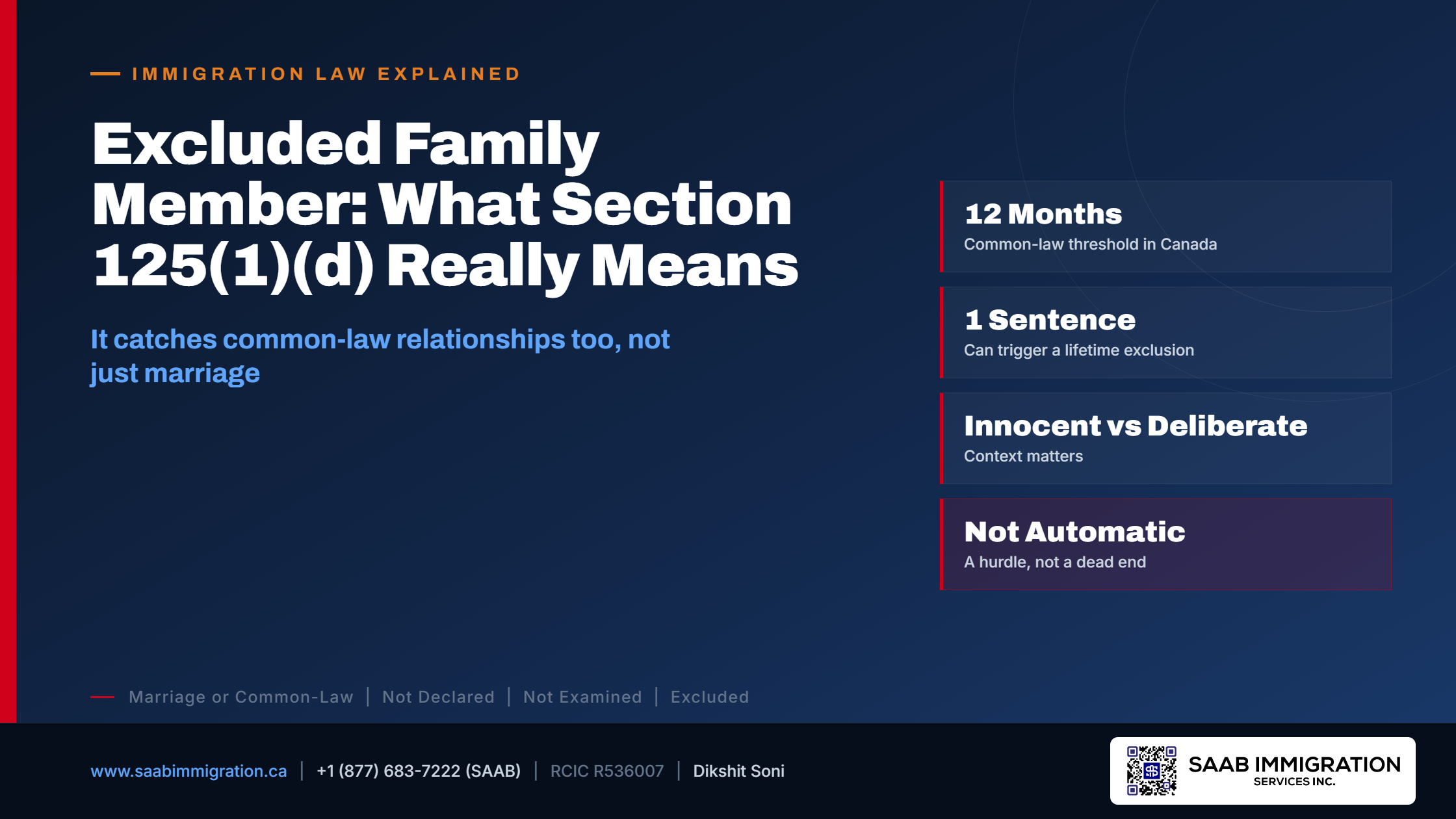
- Subsection 125(1)(d) of the IRPR bars sponsorship of a spouse or common-law partner who wasn’t declared and examined during your own PR application
- It applies whether the marriage or common-law relationship was hidden deliberately or simply never disclosed by mistake
- Common-law relationships trigger this just as often as marriage, and are far less understood, since 12 months of living together in a committed relationship counts even without a wedding
- The rule exists because of medical, security, and criminality screening requirements, not sponsorship timing
- Being caught by this exclusion is a serious legal hurdle, not an automatic dead end
If you’ve been told your spouse or partner can’t be sponsored because they’re an “excluded family member,” this is the rule behind that answer, and it’s worth understanding properly before you assume there’s nothing to be done.
What Subsection 125(1)(d) Actually Says
Subsection 125(1)(d) of the Immigration and Refugee Protection Regulations sets out one of the narrowest but most consequential exclusions in the entire family sponsorship system. In plain terms: if you became a permanent resident of Canada, and at the time of that application you had a spouse who wasn’t declared to IRCC and wasn’t examined as part of your file, that spouse cannot later be sponsored under the Spouse or Common-Law Partner in Canada class.
The exclusion applies regardless of intent. It doesn’t matter whether the non-declaration was a deliberate attempt to hide a relationship or an honest mistake caused by bad advice, confusion, or simply not understanding that it applied. On its face, the regulation doesn’t distinguish between the two. That’s what makes this provision so unforgiving, and why so many people who encounter it are told, flatly, that there’s no way around it.
How This Actually Happens in Real Life: Marriage
This isn’t usually a story about someone trying to game the system. The most common version looks something like this: someone gets married shortly before or during their own permanent residence process, often in the window between receiving approval and actually landing in Canada. Their representative at the time, whether a lawyer, a consultant, or someone posing as one, doesn’t flag that the marriage needs to be declared before the file is finalized. The person assumes, reasonably, that sponsoring their new spouse is simply a next step they can take once they’re settled in Canada.
The Version Almost Nobody Talks About: Common-Law Relationships
This is just as important, and it catches far more people off guard, because it doesn’t require a wedding at all.
Under Canadian immigration law, you’re considered common-law partners if you’ve been living together in a conjugal, marriage-like relationship for at least twelve continuous months. That’s it. No ceremony, no paperwork, no formal declaration required for the relationship to legally exist in the eyes of IRCC. The problem is that this definition doesn’t match how a lot of cultures and countries think about relationships. In many places, “common-law” as a legal concept simply doesn’t exist the same way, and people genuinely don’t realize that living with a partner for over a year, without ever marrying, already meets Canada’s legal definition of a relationship that needs to be disclosed.
So here’s exactly where things go wrong: someone applies for their own permanent residence while already living with a partner for more than a year. They don’t think of themselves as being in a “common-law relationship,” because that’s not a category that exists in their home country or culture the way it does here. So they don’t declare it, not out of any intent to deceive, simply because they didn’t know it applied to them. Their PR goes through. Years later, they try to sponsor that same partner as a spouse, and IRCC’s review of the relationship timeline shows the couple was already living together, in a committed relationship, for over a year before the PR was granted. That triggers the exact same exclusion under subsection 125(1)(d), just as it would for an undisclosed marriage.
We see this pattern often. It is genuinely avoidable: understanding what counts as common-law under Canadian law, and disclosing it at the right time, prevents this problem entirely. But if it’s already happened, it isn’t the end of the road either. We’ve successfully worked through many cases exactly like this.
Why the Rule Exists
The real reason behind subsection 125(1)(d) comes down to medical and security admissibility. When you apply for permanent residence, every family member you have, whether they’re coming with you or not, is legally required to be examined for admissibility at that same time. That includes medical exams, security screening, and criminality checks. This exists because if even one family member is inadmissible, it can affect the sponsor’s own application, since inadmissibility findings aren’t necessarily isolated to just the person being examined.
If you have a spouse or common-law partner and you don’t declare them, that person skips this examination entirely. Nobody checks their medical history, their security background, or anything else at the point where it’s supposed to happen. Subsection 125(1)(d) exists to prevent a sponsor from later trying to bring in a spouse who was never actually screened when they should have been, at the time the sponsor’s own permanent residence was assessed. Wanting to wait and sponsor a spouse later, rather than right away, is often a genuine, ordinary decision. That’s not really what this provision is targeting. It’s the fact that skipping the declaration means skipping the screening, and that gap is what the exclusion is built to close.
The problem, again, is that the rule doesn’t distinguish between someone who skipped disclosure to avoid a real admissibility issue and someone who simply didn’t know their marriage or common-law relationship needed to be declared at all. Both get caught by the same exclusion.
Does This Mean the Sponsorship Is Permanently Dead?
Not necessarily. This is the part that gets lost in most of the panic around this section. Canadian immigration law and IRCC’s own guidance recognize, in principle, that context matters: an honest, innocent mistake, whether from bad advice, cultural unfamiliarity with the common-law concept, or simple confusion, is not treated the same way as deliberate misrepresentation when a case is properly presented, with real documentation and a clear account of what happened and why.
That doesn’t mean every case succeeds. It means the exclusion is a serious legal hurdle, not an automatic dead end, and the strength of your explanation, your documentation, and how the case is framed makes a real difference to the outcome.
📊 What You Can Actually Do If You’ve Been Told You’re an Excluded Family Member
- Provide a full, documented explanation of exactly how and why the marriage or common-law relationship wasn’t declared
- Request humanitarian and compassionate consideration where the circumstances warrant it
- Pursue reconsideration or appeal where appropriate, depending on the stage the file is at
- Have the specific facts of your case properly assessed, since the right path depends heavily on how the non-disclosure happened, how much time has passed, and whether dependent children or other compelling circumstances are involved
We recently helped a family work through exactly this issue after sixteen years of separation caused by this exact provision. If you want to see how a real file like this can actually turn around, we’ve written up that full case study here.
The Simplest Way to Avoid This Entirely
If you’re currently in the immigration process and living with a partner, married or not, take the time to actually understand what counts as a spouse or common-law partner under Canadian law, and disclose it properly at the right stage. It’s a small step that prevents a genuinely painful, years-long problem down the line. And if you’ve already been through this without knowing, it’s still worth getting your file properly assessed rather than assuming the door is closed.
Book a Consultation or call +1 (877) 683‑7222 (SAAB) or email us at hello@saabimmigration.ca.
